Must see in rome italy: the essential places (and how to enjoy them)
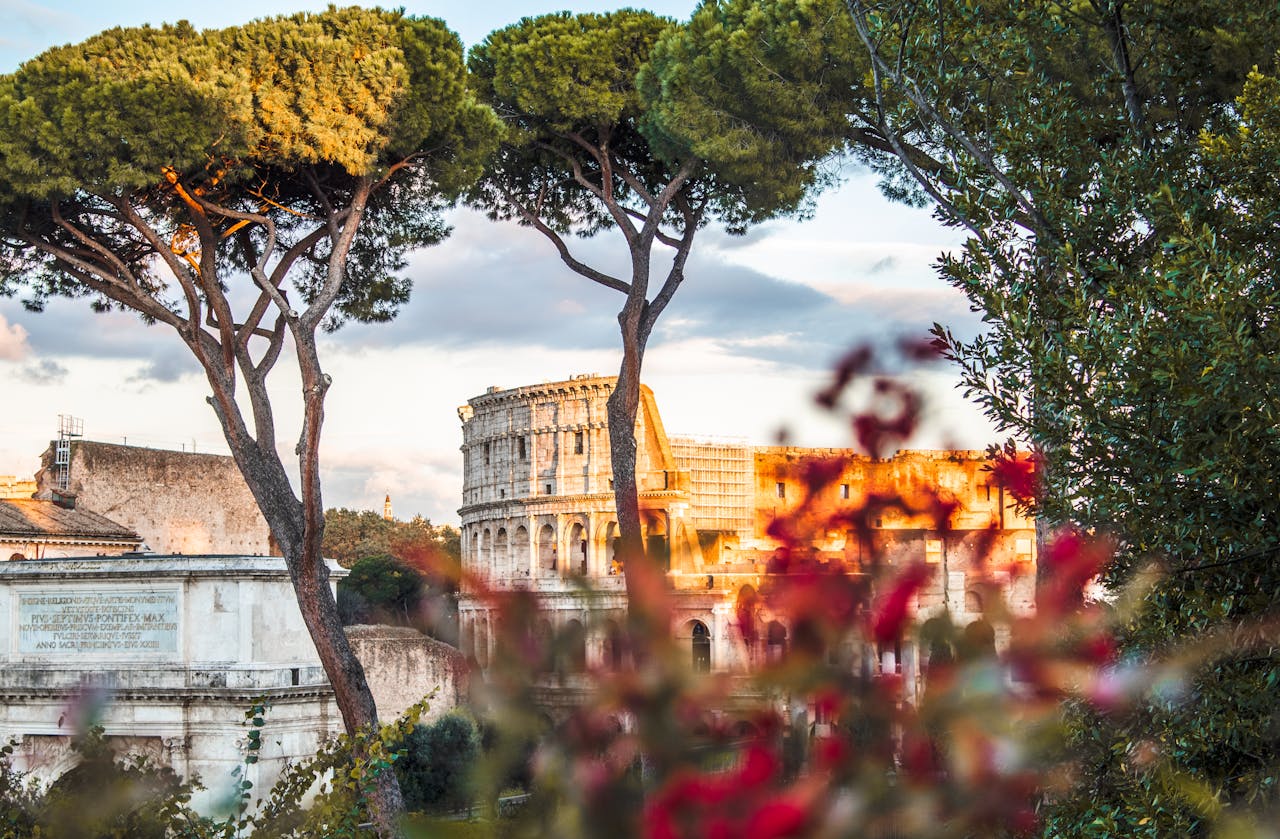
You came for the icons—Colosseum, Vatican, Trevi—but you also want the feel of Rome: narrow lanes, baroque churches, busy markets, twilight piazzas. In this guide, I show you the must see in Rome Italy sights and how to plan them in a simple, stress-free way. You’ll get clear tips, short routes, and a tiny packing note (hello, comfy shoes).
I’ll keep the language easy and practical so you can scan on the go.
Ancient Rome in one glance: stones that tell the story
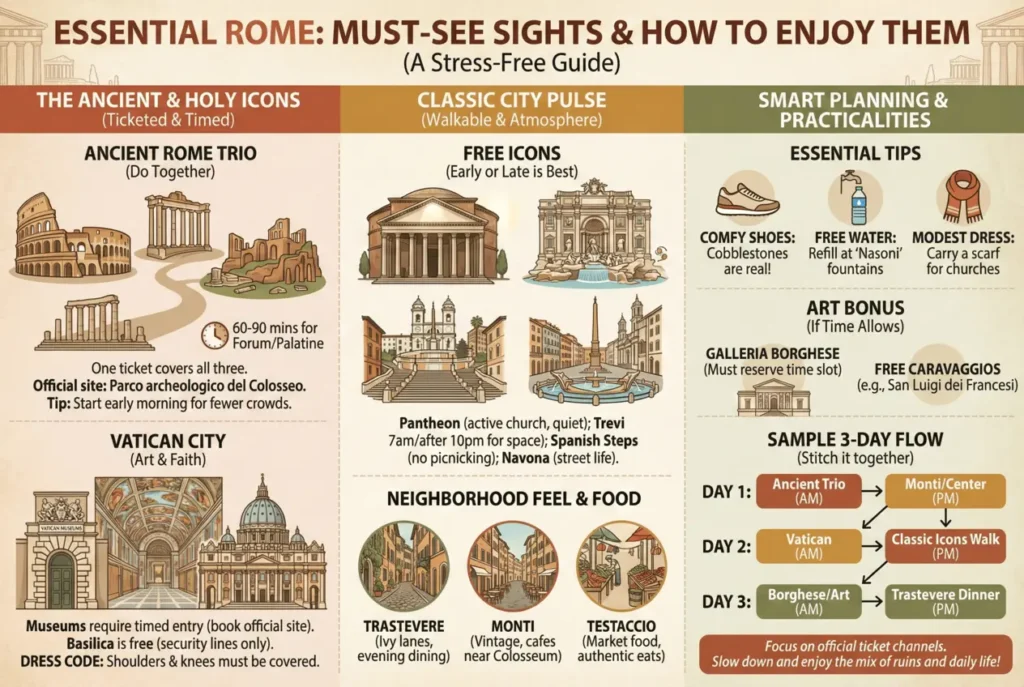
When you think of the must see in Rome Italy, ancient sites lead the list. They sit close together, so you can walk between them.
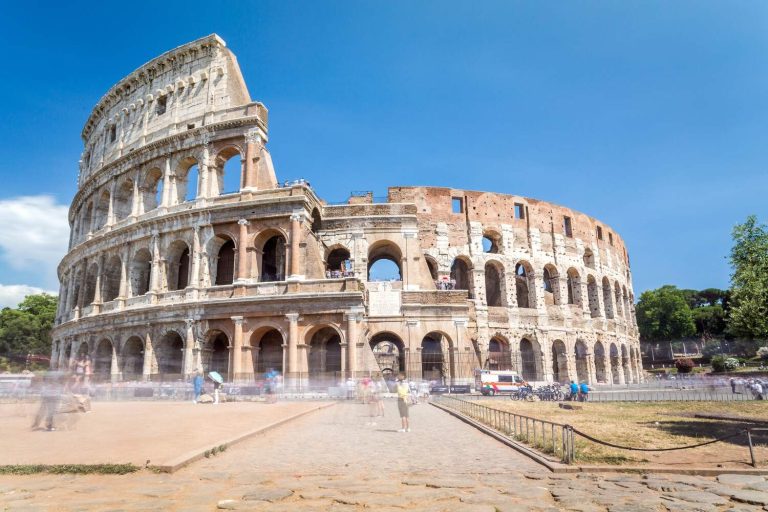
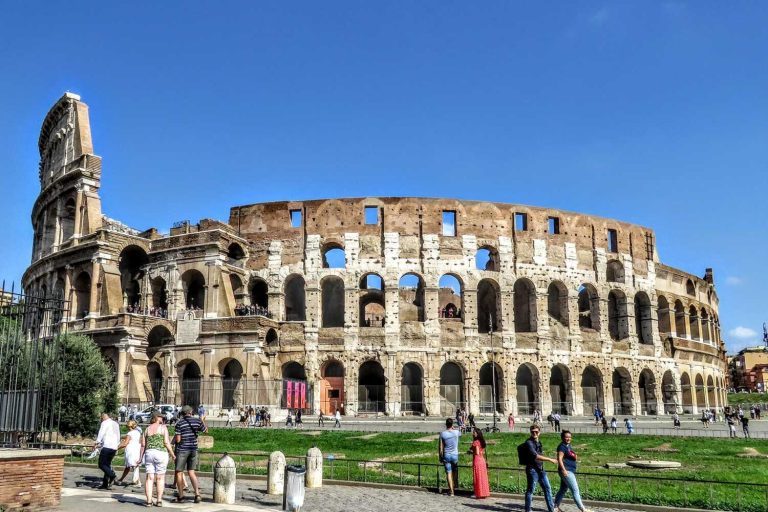
Colosseum: Rome’s big stage
Step inside to picture the roar of 50,000 people. Timed entry keeps lines flowing, and the arena floor/underground add drama if you book those options. Mornings are quieter; late afternoons glow at golden hour. For official details and tickets, use the Parco archeologico del Colosseo’s channels; their pages cover the Colosseum, Palatine Hill, and Forum together.
Trust source inside text: Check the official Colosseum & Roman Forum site for passes and updates.
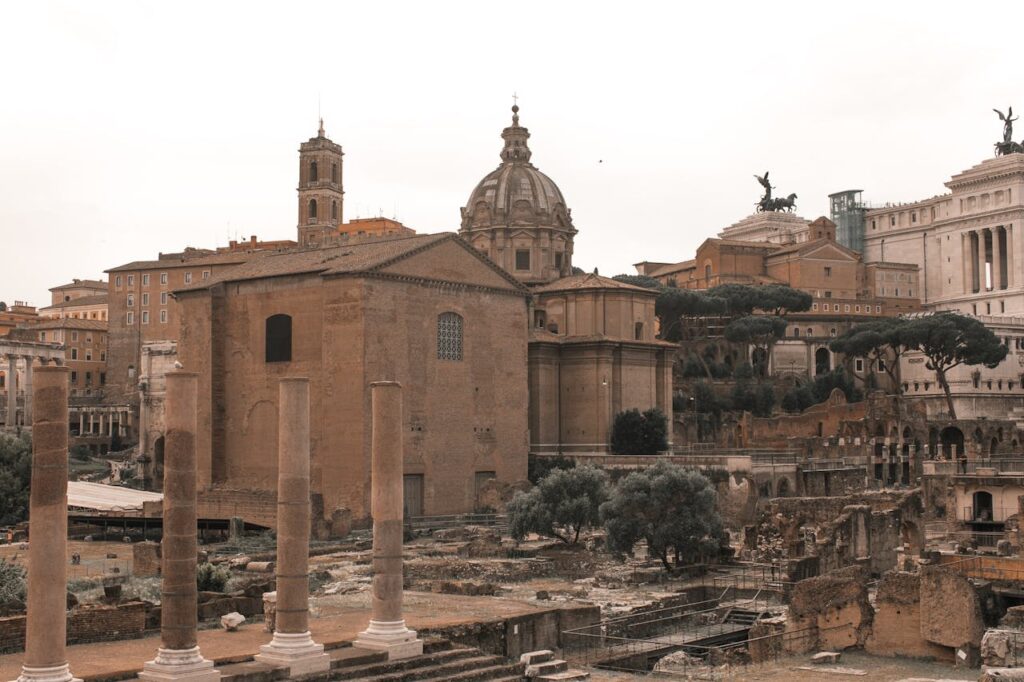
Roman Forum: daily life, frozen
This valley was the city’s social heart. Walk the Via Sacra, find the Arch of Titus, and climb toward the Palatine for sweeping views back over the Forum. Plan 60–90 minutes; shade is limited, so bring water.
Palatine Hill: where emperors lived
You’ll see palace ruins, gardens, and a skyline that explains Rome’s layers at a glance. It’s the most peaceful part of the trio and a perfect spot to slow down.
Mini-summary: Do these three together. One ticket, one security check, a full picture of ancient Rome.
Vatican City highlights: art, faith, and that dome
Even if you’re not a museum person, the Vatican is a true must see in Rome Italy because of its sheer scale and meaning.
Vatican Museums & Sistine Chapel
The collection is vast, but you can focus on the highlights route: Pinecone Courtyard → Gallery of Maps → Raphael Rooms → Sistine Chapel. The chapel is a quiet space—no photos, shoulders covered. If you like early starts, “first-entry” slots are worth it.
Trust source inside text: See the official Vatican Museums site for opening times, access rules, and tickets.
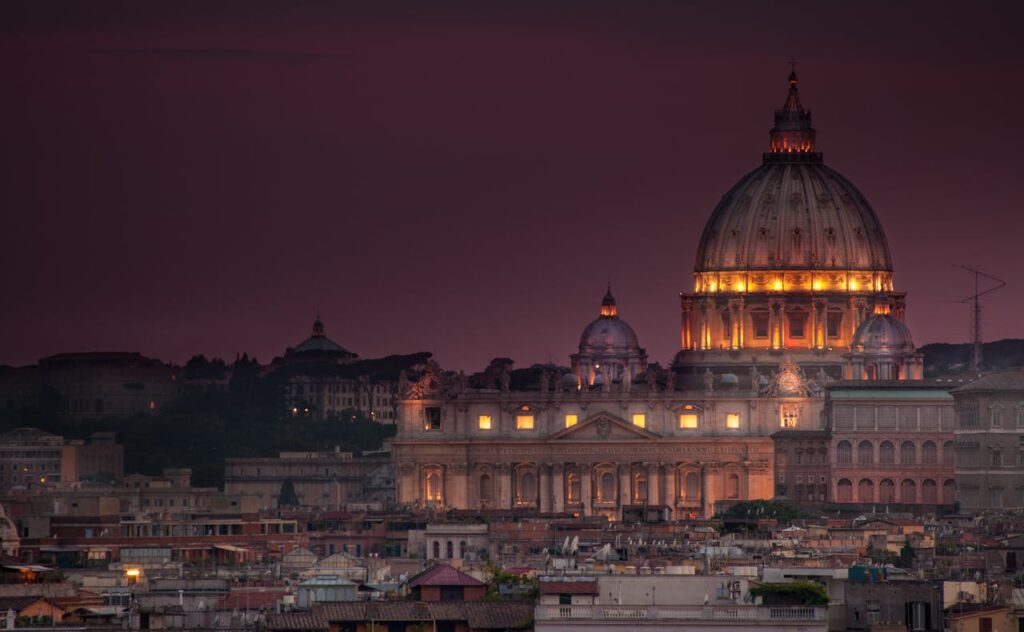
St. Peter’s Basilica
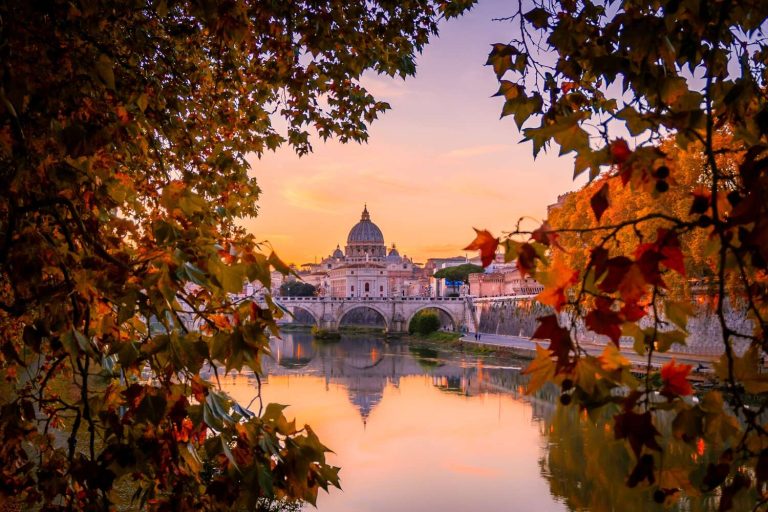
It’s free to enter (security line only). Climb the dome for a 360° view over Bernini’s colonnade and the Tiber. Dress modestly (shoulders/knees covered). Early morning or late afternoon helps you avoid the longest queues.
Pro tip: Do the museums first (timed), then walk around the walls to the basilica. If the square is very busy, consider visiting St. Peter’s on a different morning.
Classic city icons you’ll remember
These are the places people picture when they say places to visit in Rome and things to do in Rome Italy. They’re free or low-cost and easy to mix with coffee breaks.
Pantheon
Ancient temple turned church with the world’s largest unreinforced concrete dome. Step inside to feel the light from the oculus. It’s an active church, so keep voices low and dress respectfully.
Trevi Fountain
Yes, it’s crowded—and yes, it’s magical at night. Stand with your back to the water and toss a coin over your right shoulder. Arrive very early (before 7am) or late (after 10pm) for space to breathe and better Trevi Fountain photos.
Spanish Steps
Sit, watch, and don’t picnic on the steps (local rules fine that). Climb to Trinità dei Monti for a sunset view over rooftops.
Piazza Navona
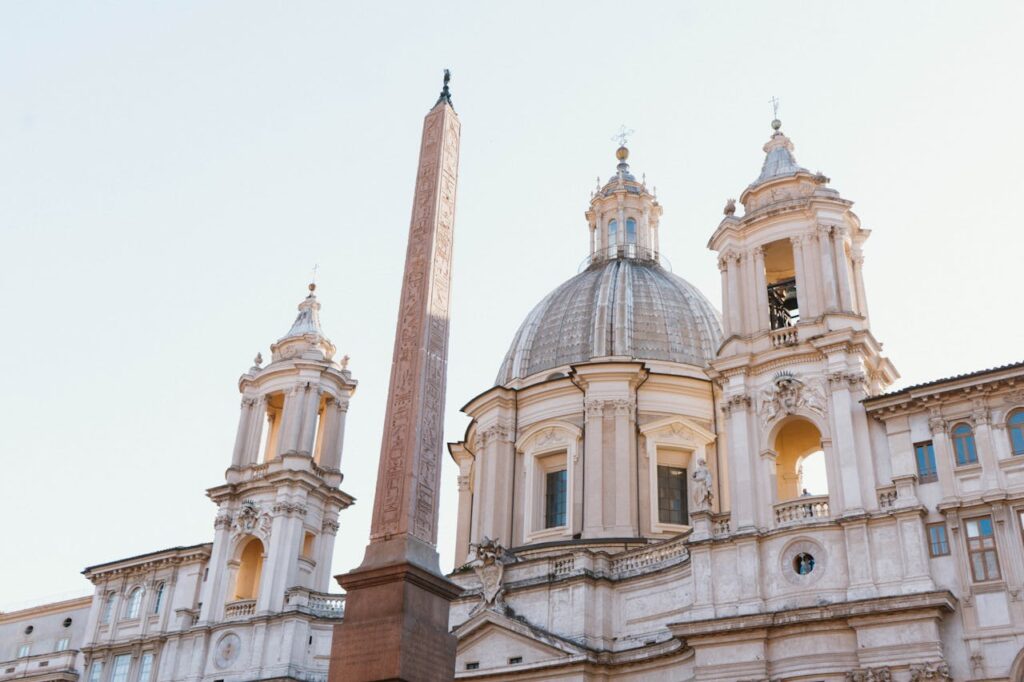
Baroque fountains, street artists, and lively cafés. Pop into Sant’Agnese in Agone to admire the interior, then hunt a gelato within a block or two.
Churches & art beyond the headlines
If your list says top 10 things to see in Rome, add one or two art stops. You don’t need to be an expert.
- Galleria Borghese (museum): A compact masterpiece—Bernini’s sculptures, Caravaggio’s canvases—set inside a villa in Villa Borghese park. You must reserve a time slot; two hours is the standard visit window.
- Capitoline Museums: Overlook the Forum from the terrace and see the bronze Marcus Aurelius.
- Santa Maria del Popolo: Two Caravaggios in a side chapel—small detour, huge impact.
- San Luigi dei Francesi: Another trio of Caravaggios (free entry; quiet mid-afternoon).
Neighborhoods to feel the city (like a local)
A list of monuments is great, but the must see in Rome Italy also includes neighborhoods where you can just be.
Trastevere
Cross the Tiber for ivy-draped lanes, trattorie, and after-dark energy. Visit the mosaics in Santa Maria in Trastevere, grab supplì (fried rice balls), and stroll Via della Lungaretta in the evening.
Jewish Ghetto & Teatro di Marcello
Taste carciofi alla giudia (fried artichokes), then walk to the Portico d’Ottavia and the little-known theater that looks like a mini-Colosseum.
Testaccio
If you care about food, this is your spot. Mercato Testaccio has pasta counters, salumi, cheese, and Roman street bites. Eat at the benches, then loop past Monte dei Cocci (ancient pottery mound).
Monti
Between the Colosseum and Termini, Monti is perfect for espresso, vintage shops, and an evening spritz around Piazza della Madonna dei Monti.
Green lungs and ancient roads
Rome isn’t only stone and marble.
- Appian Way (Via Appia Antica): Rent a bike and roll on the original basalt stones out of the city, passing aqueduct stretches, cypress trees, and catacombs.
- Villa Borghese park: Lawns, lake, and city viewpoints (Pincio Terrace).
- Orange Garden & Aventine Keyhole: Tiny moments with huge payoffs—St. Peter’s framed in a keyhole view, and a garden that glows at sunset.
Food breaks near major sights (quick wins)
You’ll need refueling between must see in Rome Italy stops. A few ideas close to big landmarks:
- Near the Colosseum/Forum: seek out a simple al taglio pizza place on Via Cavour or Via Urbana (fast, kid-friendly).
- By the Pantheon: espresso at a classic standing-bar; try a maritozzo (cream bun) if you spot it.
- Around Vatican City: walk 10 minutes east into Prati for less touristy trattorie; order cacio e pepe or carbonara.
- Gelato tip: Look for metal canisters (pozzetti) and natural colors; pistachio shouldn’t be neon green.
Sample routes (1, 2, or 3 days)
Use these to stitch your things to do in Rome Italy into an easy plan.
If you have 1 day
Morning: Colosseum → Roman Forum → Palatine (limit time to hit the highlights).
Afternoon: Pantheon → Piazza Navona → Trevi Fountain.
Evening: Spanish Steps at golden hour → dinner in Trastevere.
If you have 2 days
Day 1 (as above).
Day 2: Vatican Museums → St. Peter’s Basilica & dome → Castel Sant’Angelo photo stop → stroll Via dei Coronari → aperitivo around Campo de’ Fiori.
If you have 3 days
Days 1–2 (as above).
Day 3: Galleria Borghese (AM reservation) → Villa Borghese park → Capitoline Museums terrace → sunset on the Aventine → dinner in Testaccio.
Practicalities that save time (and stress)
- Timing: Start sights at opening time when possible; lunch crowds thin lines.
- Tickets: Official channels beat resellers on price and policy (Colosseum/Forum/Palatine together; Vatican Museums separately).
- Dress code: Churches and the Sistine Chapel expect covered shoulders/knees. Carry a light scarf.
- Shoes: Cobblestones are real. Pick supportive sneakers or flats.
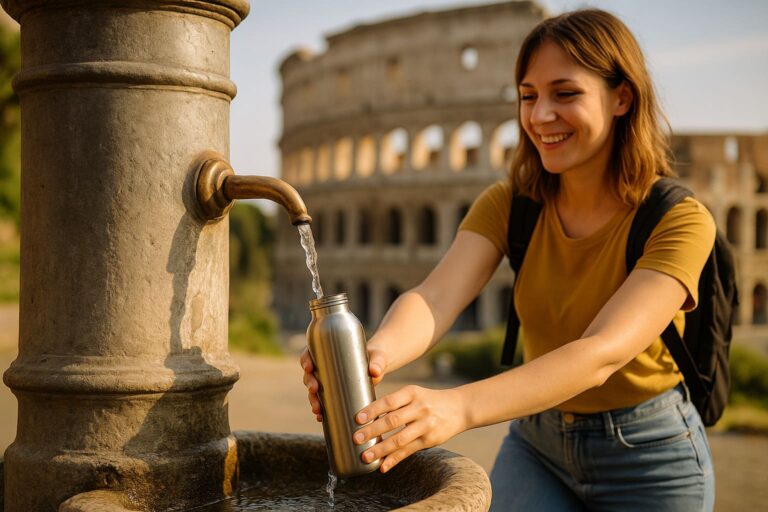
- Water: Rome’s nasoni fountains pour drinkable water all over town—refill your bottle for free.
- Pickpockets: Keep your phone/wallet zipped away on crowded transport and at the Trevi/Spanish Steps.
A quick story from the stones
On a spring morning, start at the Palatine. You walk past wildflowers pushing through brickwork. The city noise drops, and suddenly all of Rome lies below you—the Forum like a stage set, the Colosseum at the edge, the curve of the Tiber in the distance. Ten minutes later you’re in Monti, tasting a square of pizza al taglio and overhearing Roman banter. That mix—ruins, food, human noise—is why these places are truly must see in Rome Italy.
FAQ: fast answers to common questions
What are the absolute top 5 must see in Rome Italy?
Colosseum, Roman Forum & Palatine (they count as one combo), Vatican Museums & Sistine Chapel, St. Peter’s Basilica, Pantheon, and Trevi Fountain. If you have time, add Piazza Navona or the Spanish Steps.
Is two days enough for the main sights?
Yes for the highlights—do Ancient Rome on Day 1 and the Vatican on Day 2—then add Pantheon/Trevi/Spanish Steps in the gaps. Three days lets you include Galleria Borghese or the Appian Way.
Do I need guided tours?
Not always. For context, a small-group tour at the Colosseum or Vatican can be worth it. Otherwise, download official audio or read the main info panels and take it slow.
Where should I stay to see the main attractions?
For walkability, pick Centro Storico (Pantheon/Navona area) or Monti (near Colosseum). Trastevere is great for evenings and food.
What about Sundays or holidays?
The Vatican Museums are usually closed on most Sundays except special openings; St. Peter’s remains open for worship and visitors. Monuments can have special hours on holidays—always recheck official pages when you plan.
Wrap-up: a snippet you can copy
The must see in Rome Italy are the Ancient Rome trio (Colosseum, Forum, Palatine), Vatican Museums with the Sistine Chapel plus St. Peter’s Basilica, and city icons like the Pantheon, Trevi Fountain, Spanish Steps, and Piazza Navona. Do ancient sites together in the morning, save the Vatican for another day, and use the official Colosseum and Vatican links for tickets and hours.