How big is rome — size, population, and easy comparisons
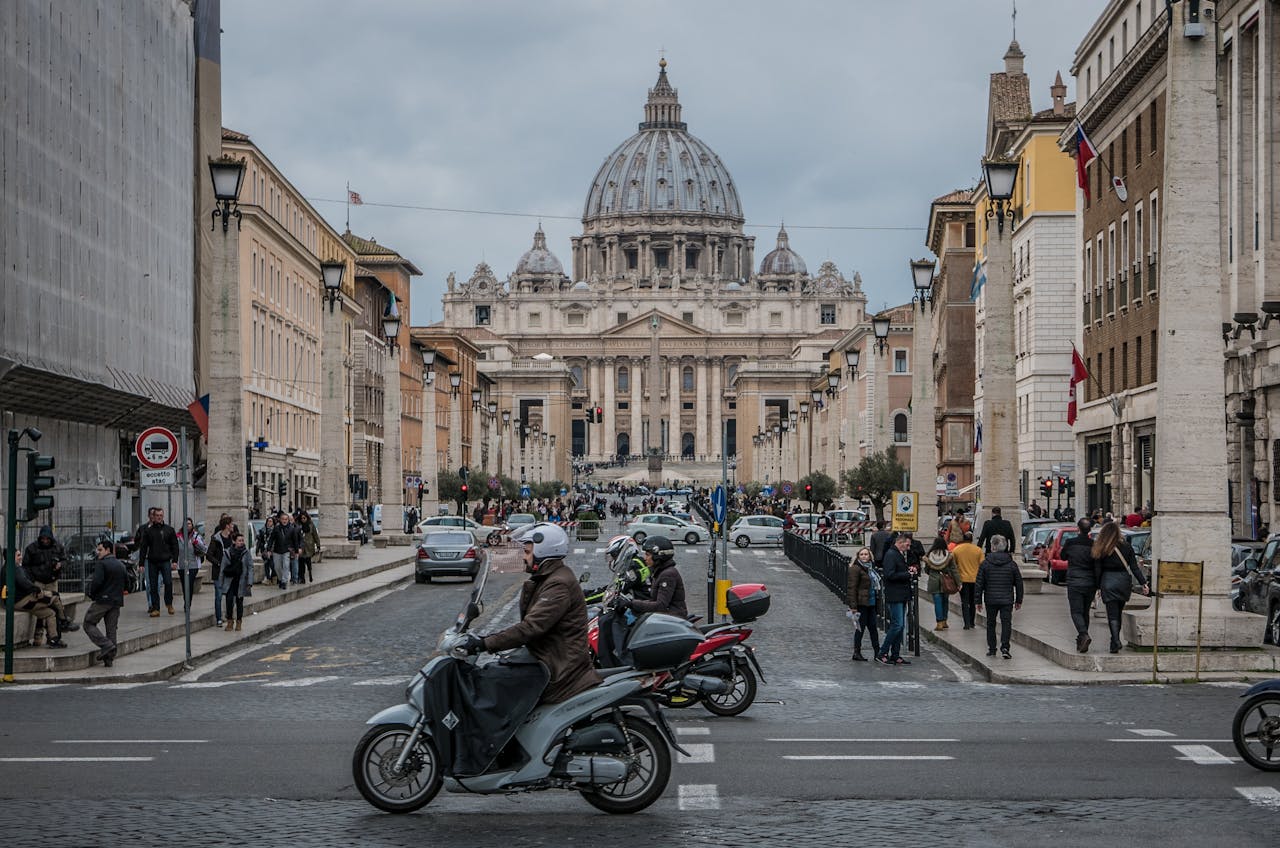
You’re asking how big is Rome because size affects everything: how long it takes to cross the city, where to book a hotel, and how much you can realistically see in a day. In the next minutes you’ll get a simple, traveler-friendly breakdown—area in km and miles, population today, how Rome compares to other famous cities, plus walkability and time-saving tips. No fluff, just what you need.
Quick answer: the size of the City of Rome today
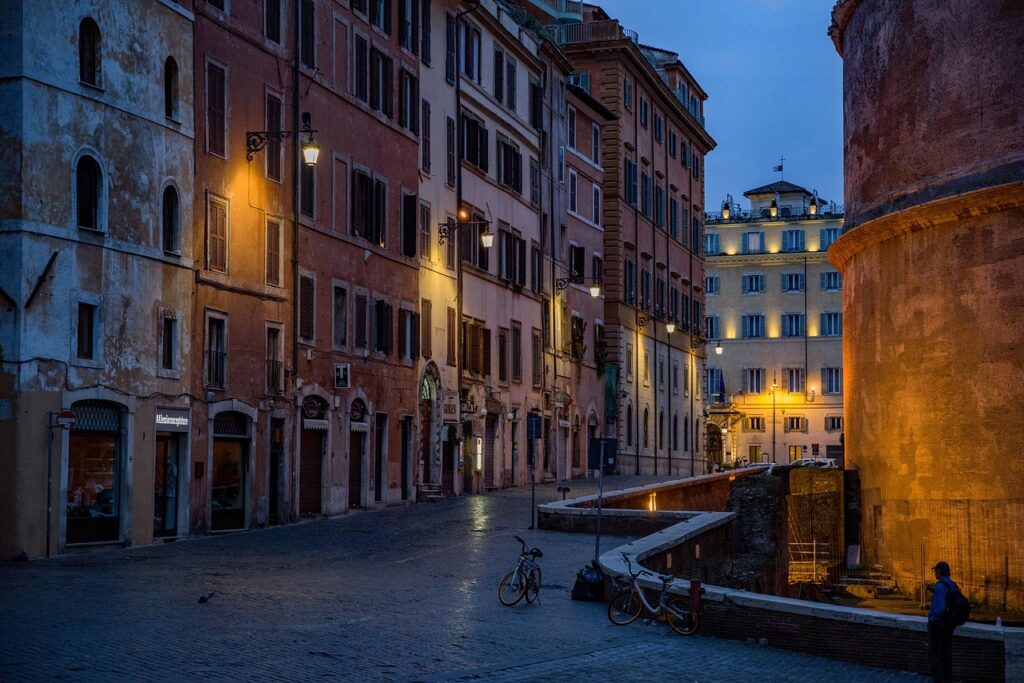
- Area (city limits): about 1,286.8 km² (≈ 497 sq mi). That’s the modern Comune di Roma—the official city boundary, not the whole metro region.
- Population (city limits): roughly 2.75–2.81 million residents depending on the snapshot date (Rome’s anagrafe and ISTAT updates). An official 2024 City Hall note states 2,754,719 in the Comune di Roma (1 Jan 2024).
how big is Rome? Very big—one of Europe’s largest capitals by land area, with a population above 2.7 million within city limits.
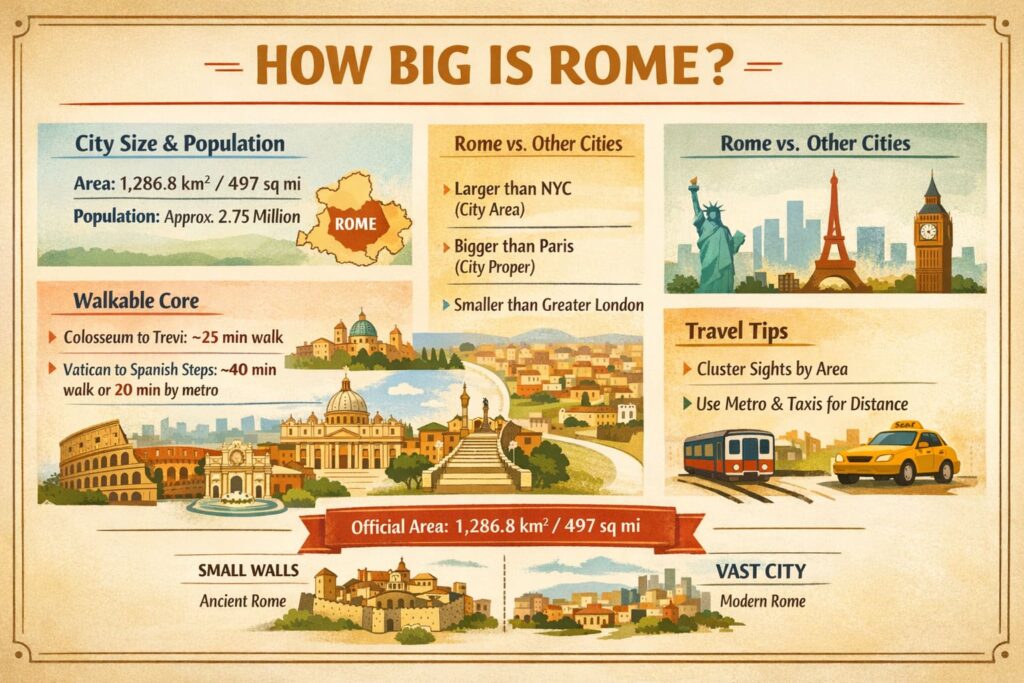
What “Rome” means (and why it changes the numbers)
When you read stats online, you’ll see at least three “Romes.” Knowing the difference keeps your planning realistic:
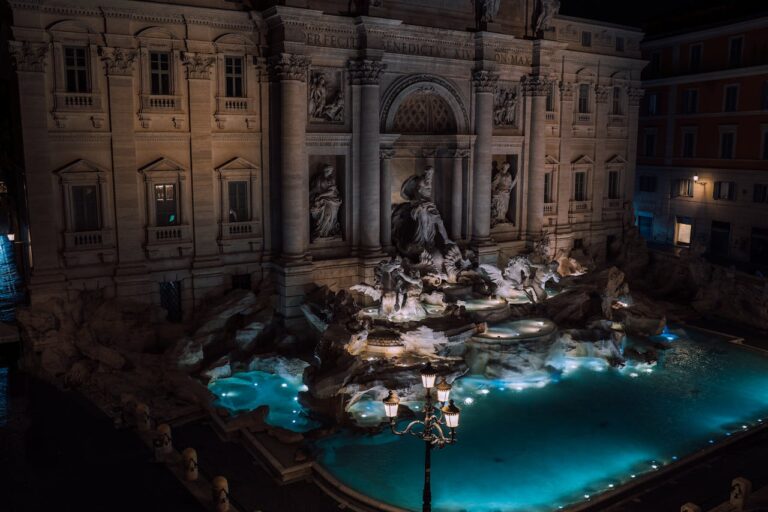
- Historic center (Centro Storico): the compact heart—Pantheon, Trevi Fountain, Piazza Navona—walkable, dense, full of sights.
- City of Rome (Comune di Roma): the official municipality. This is the 1,286.8 km² figure above. Parks, peripheral neighborhoods, and even rural zones make the land area huge.
- Metropolitan City of Rome: a much larger administrative region that includes surrounding towns and countryside. Helpful for airport transfers, seaside day trips (Ostia), and vineyard escapes—but not what most travelers mean by “Rome.”
When someone asks how big is Rome, they usually mean the Comune. That’s what we’re using throughout unless noted.
Is Rome walkable? Yes—but it’s spread out
Rome’s historic core is very walkable: think 2–4 km stretches between big sights. For example, Colosseum → Trevi → Spanish Steps → Piazza del Popolo forms a scenic northbound arc you can tackle in a half-day if you keep moving.
But Rome’s overall footprint is wide. The city includes the Vatican on the west, ancient sites in the center, and large green areas and residential districts that sprawl outward. Plan to mix walking with metro/bus to save time (and your feet).
Time guide you can actually use:
- Colosseum → Trevi Fountain: ~25–30 min on foot (about 2 km / 1.2 mi).
- Trevi → Spanish Steps: ~10–12 min.
- Spanish Steps → Vatican Museums: 35–45 min walking; the metro trims this to ≈20–25 min including transfers/waits.
How big is Rome compared to cities you know?
You asked for simple comparisons—here’s the plain-English version travelers find useful:
- Versus Paris (city proper): Rome covers far more land than Paris city proper. That’s why Paris feels “denser” and “closer,” while Rome feels roomier with giant archaeological parks.
- Versus New York City (land area): Rome’s city area is bigger than NYC’s land area, which surprises many people. Yet NYC can feel taller and denser; Rome spreads its weight across more low-rise neighborhoods, ancient sites, and parkland.
- Versus Greater London: London’s administrative region is bigger than Rome by area, but day-to-day sightseeing distances inside both historic cores feel comparable.
Takeaway: how big is Rome? Big enough that you should cluster your plans by neighborhood and use public transport between clusters.
Population, density, and how the city “feels”
With roughly 2.75–2.81 million people inside the city boundary, Rome’s average density is moderate: plenty of lively streets, yet lots of airy spaces (the Appian Way, the Borghese gardens, and the archaeological park around the Forum/Palatine). That balance is part of Rome’s charm: you can step from a buzzing piazza into a quiet ruin-dotted meadow in minutes.
What this means for you:
- Expect busy centers (Pantheon area, Trastevere evenings, Vatican corridor) and breathing room in large parks and along ancient roads.
- Plan early starts for the top three: Colosseum, Vatican Museums/Sistine Chapel, and Trevi Fountain.
Ancient Rome vs. today: the footprint then and now
When people wonder how big is Rome, they sometimes mean the ancient walled city. The short version:
- Early walls (Servian): small, hugging the original hills.
- Later walls (Aurelian): enclosed a footprint often summarized as a few dozen square kilometers—tiny versus today’s municipality—yet enormous for the ancient world.
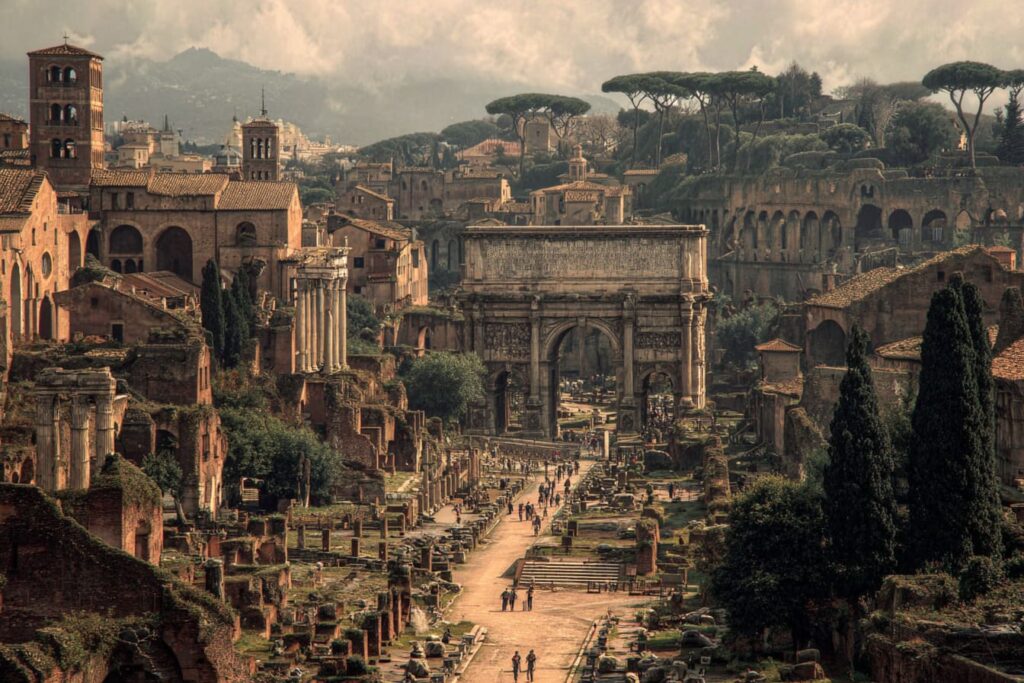
- Modern expansion: 19th–20th-century growth pushed across the Tiber and beyond, adding residential districts, boulevards, and parks. Today’s city boundary includes wide green belts and suburban areas that make the 497 sq mi figure possible.
For travelers, this explains why the “old Rome” you picture is compact and walkable—but the official, modern Rome is vast.
How the size of Rome shapes your itinerary
1) Group sights by zone.
Build your days around tight clusters to avoid zig-zagging across a huge city:
- Ancient core: Colosseum, Roman Forum, Palatine Hill, Capitoline, Circus Maximus.
- Baroque spine: Pantheon, Trevi Fountain, Spanish Steps, Piazza Navona.
- Vatican zone: St. Peter’s Basilica, Vatican Museums, Sistine Chapel, Castel Sant’Angelo.
- Trastevere & Janiculum: cobbled lanes, trattorie, hilltop views.
2) Use the metro to “leap.”
Two or three metro hops can save an hour of back-and-forth walking. Roma Termini is your main hub; Ottaviano (for Vatican Museums) and Colosseo stops are your anchors west/east.
3) Book smart based on distance.
If food nights in Trastevere matter to you, stay in Trastevere or across the bridge in Campo de’ Fiori to keep walks short. If early Vatican entry is your priority, Prati is a great base. Shorter transfers = more gelato time.
Neighborhood scale: quick feel for distances
- Centro Storico width: crossing the heart (Piazza del Popolo → Colosseum) is roughly 4–5 km on foot with photo stops.
- Vatican to Colosseum: about 4–5 km; metro or bus cuts it in half time-wise.
- Termini to Trastevere: walking is long and not lovely the whole way; tram/bus is better in most cases.
Your core sightseeing happens within a compact inner oval, but remember: how big is Rome overall? Big enough that a taxi or metro between clusters often pays off.
Rome today vs. regions and day trips
Rome’s city boundary includes coastal districts (Ostia/Lido di Ostia) and reaches toward the Castelli Romani. That’s why the Comune feels “huge” on the map. But many classic day trips—Tivoli, Frascati, Ostia Antica—sit just outside or at the edges, so trains and regional buses make more sense than long city bus routes.
Practical planning: time, transport, and expectations
- Two full days: focus on one big anchor per day (e.g., Day 1 Colosseum/Forum; Day 2 Vatican), plus one compact neighborhood walk.
- Three days: add the Baroque spine loop and Trastevere dinner.
- Four days or more: layer in a museum (Capitolini or Borghese), catacombs/Appian Way, or a food tour.
Why this matters to how big is Rome: you’ll spend less time crossing and more time soaking it in.
Mini-guide: area, miles & mental map
- Official area: ≈ 1,286.8 km² / 497 sq mi (Comune di Roma).
- Population snapshot (2024): ≈ 2.75 million (Comune di Roma)
- Core sightseeing oval: walkable, but use metro/taxis for long hops.
- Why it feels big: parks, ruins, wide municipal boundary, and many districts.
Story moment: the “Rome is bigger than I thought” day
A common traveler story goes like this: you start near the Colosseum and feel like everything is right there. You stroll to the Pantheon, toss a coin at Trevi, climb the Spanish Steps… easy. Then you decide to “quickly pop over” to the Vatican Museums before sunset. On the map it’s a short line; in real life it’s a long, cross-city push—and your legs feel every cobblestone. The moral? In a city this big, stringing zones together is fine if you budget time or jump on the metro between them.
FAQs (quick, skimmable answers)
Is Rome bigger than New York City?
By land area, Rome’s city territory is larger than NYC’s land footprint, even though New York feels taller and denser. Different urban forms create different “size” sensations.
How many people live in Rome today?
About 2.75–2.81 million in the Comune di Roma (city limits). The wider metro adds more.
How big is Rome in miles?
≈497 square miles for the municipality (that’s the official city boundary, not just the historic center).
How big was Ancient Rome compared to modern Rome?
The ancient walled city covered only a fraction of today’s area—compact and walkable—but it was enormous for its time and packed with monuments that still anchor your itinerary.
Why does Rome feel spread out?
Because parks, archaeological zones, and low-rise neighborhoods fill much of the land. Short sight-to-sight walks are great, but cross-city links are best by metro or taxi.
Conclusion
How big is Rome? The modern City of Rome covers about 1,286.8 km² (≈497 sq mi) and counts around 2.75 million residents inside city limits. The historic center is walkable, but the overall city is vast, so combine neighborhood clusters with metro/taxi hops for an easy, time-smart trip.