Did rome conquer greece — timeline, reasons & what changed
You’re asking “did Rome conquer Greece?” because you want a straight answer that fits real travel-and-history research: the when, the how, the why, and what daily life looked like afterward. In this guide I’ll keep the language simple, add a clean timeline, and show you what actually changed in ancient Greece once the Roman Empire took control.
The short answer (with the key dates)
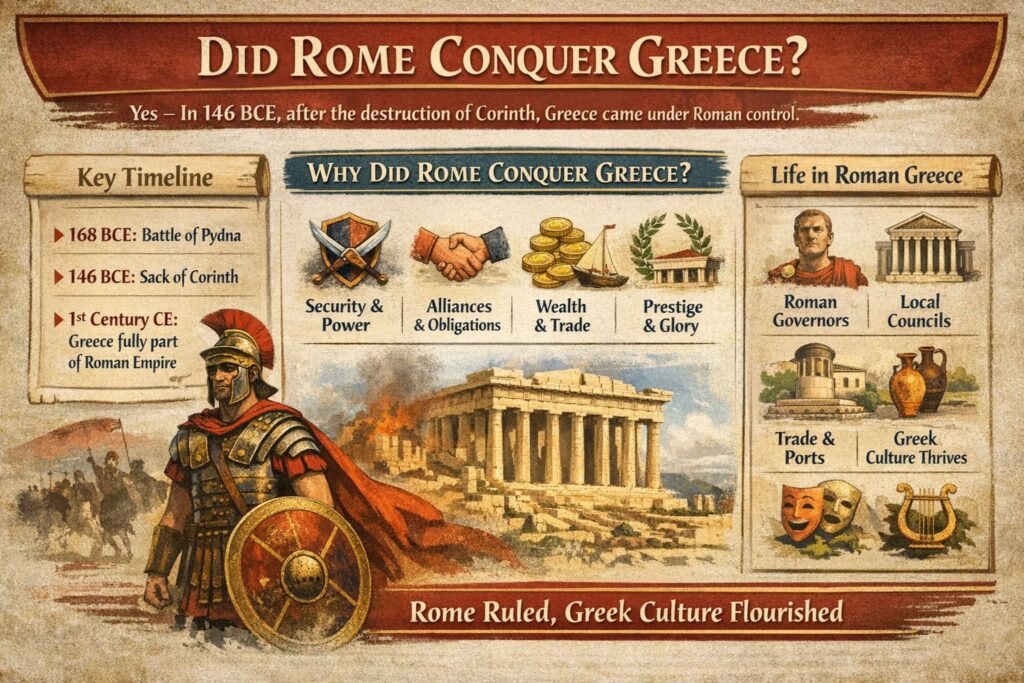
Yes. If you’re wondering “did Rome conquer Greece?” the answer is that Rome gained decisive control in a series of wars, not in a single day or campaign:
- 168 BCE — Battle of Pydna: Rome crushed the Macedonian kingdom, ending the power that had once dominated Greece after Alexander. This was the turning point that made Roman supremacy inevitable.
- 146 BCE — Achaean War & the sack of Corinth: Rome smashed the last organized resistance in southern Greece and imposed direct oversight on Greek cities. From this moment, Greece was effectively under Roman rule.
Rome didn’t rename everything overnight, but from 146 BCE onward Greek cities answered to Rome, and the political map shifted to suit Roman interests. (Later, under Augustus, formal provincial arrangements were refined.)
How Rome got there: from influence to control
If you keep asking “did Rome conquer Greece?” you’re really asking how a city from central Italy ended up ruling the Greek world. The path ran through the Macedonian Wars—four conflicts in the 3rd–2nd centuries BCE that gradually dismantled the Hellenistic balance of power.
What set the conflict in motion
- After defeating Carthage in the west, Rome faced new obligations and opportunities in the east. Alliances, trade, and security drew Roman armies across the Adriatic.
- Macedonia, heir to parts of Alexander’s empire, still had prestige and heavy infantry (phalanx) but was now competing with flexible Roman legions backed by Italian and Greek allies.
Why Pydna (168 BCE) mattered so much
Pydna is the simple answer behind “did Rome conquer Greece?” The Macedonian phalanx was lethal on flat ground, but once terrain broke its cohesion, Roman legionaries—short swords, close-in fighting—tore it apart. After Pydna, the Macedonian monarchy was abolished; without that anchor, Greek leagues could not resist Rome in the long run.
From protector to ruler
In the generation after Pydna, Rome tried ruling indirectly—encouraging “autonomous” cities and leagues as long as they stayed cooperative. When resistance revived in the Achaean League, the Romans answered decisively in 146 BCE, destroying Corinth and dissolving broad Greek political autonomy. The message was clear: Rome was in charge.
“When did Rome conquer Greece?” — a timeline you can trust
Many readers want a single year for “did Rome conquer Greece?” History is messier, so here’s a clean timeline:
- 214–205 BCE: First Macedonian War — limited results, but Rome enters Greek politics.
- 200–197 BCE: Second Macedonian War — Roman victory weakens Macedonia.
- 168 BCE: Battle of Pydna — decisive Roman win; Macedonian monarchy ends.
- 148 BCE: Further settlement; Macedonia becomes a Roman province.
- 146 BCE: Achaean War; Corinth is destroyed; Greece brought under direct Roman oversight.
- 1st century BCE → 1st century CE: Provincial organization evolves; Greece is fully integrated into the Roman Empire.
If you’re writing a report or planning museum stops, the headline year is 146 BCE—that’s the best one-line answer to “did Rome conquer Greece?”
Why did Rome conquer Greece?
When people ask “did Rome conquer Greece?”, the next question is why. Several motives overlapped:
- Security: Roman leaders feared any strong eastern kingdom could threaten Italy or Roman allies.
- Allies & obligations: Greek cities often invited Roman help—then found Roman influence hard to shake.
- Prestige & politics: Victory in the glamorous Greek East boosted Roman generals and their careers back home.
- Wealth & access: Control of ports, trade routes, and tribute fed Rome’s economy and soldiers.
Rome didn’t hate Greek culture—quite the opposite. As the poet Horace later put it, “Graecia capta ferum victorem cepit” (“Captive Greece captured her fierce conqueror”). Roman elites studied Greek language, philosophy, art, and rhetoric even as their armies ran the government.
How did daily life change for Greeks?
Answering “did Rome conquer Greece?” also means explaining what Greeks felt on the ground. Change showed up in waves rather than a single shock.
- Politics: City assemblies and councils continued, but governors and Roman law had the final word.
- Economy: War damage hurt some regions (e.g., Corinth in 146 BCE), but peace under Rome later stabilized trade; ports and roads tied Greece to Italy and the wider Mediterranean.
- Culture: Greek language stayed dominant in the East. Greek teachers, doctors, and artists were stars in Rome; Greek theaters and festivals kept thriving.
- Religion: Greek and Roman gods blended; emperors received honors in Greek cities alongside local cults.
In short: Rome ruled; Greek culture led.
Was it fast or slow? (People Also Ask)
How long did it take?
If your query is “did Rome conquer Greece” and how long did it take, think of half a century from Rome’s deep entry (c. 200 BCE) to full control (146 BCE). The decisive military step was Pydna (168 BCE); the political finishing blow came with Corinth in 146 BCE.
Did Rome ever not conquer Greece?
Before 168 BCE, Rome acted more like a power broker than a conqueror, nudging Greek states and kings to keep the peace. After 146 BCE, there was no doubt who called the shots.
What “Roman Greece” looked like
You’ll see scholars talk about Late Antiquity, Hellenistic legacies, and Roman provinces. Practically:
- Cities: Athens, Sparta, Rhodes, and others remained recognizable communities with local pride.
- Provinces: Administration evolved; Macedonia sat to the north; the southern mainland and the Aegean islands were managed along Roman lines (later known as Achaea under the empire).
- Everyday life: Markets, stone theaters, stoas, bathhouses, and temples kept the classical feel while adding Roman touches like forums, baths with hypocaust heating, and Latin inscriptions near Greek ones.
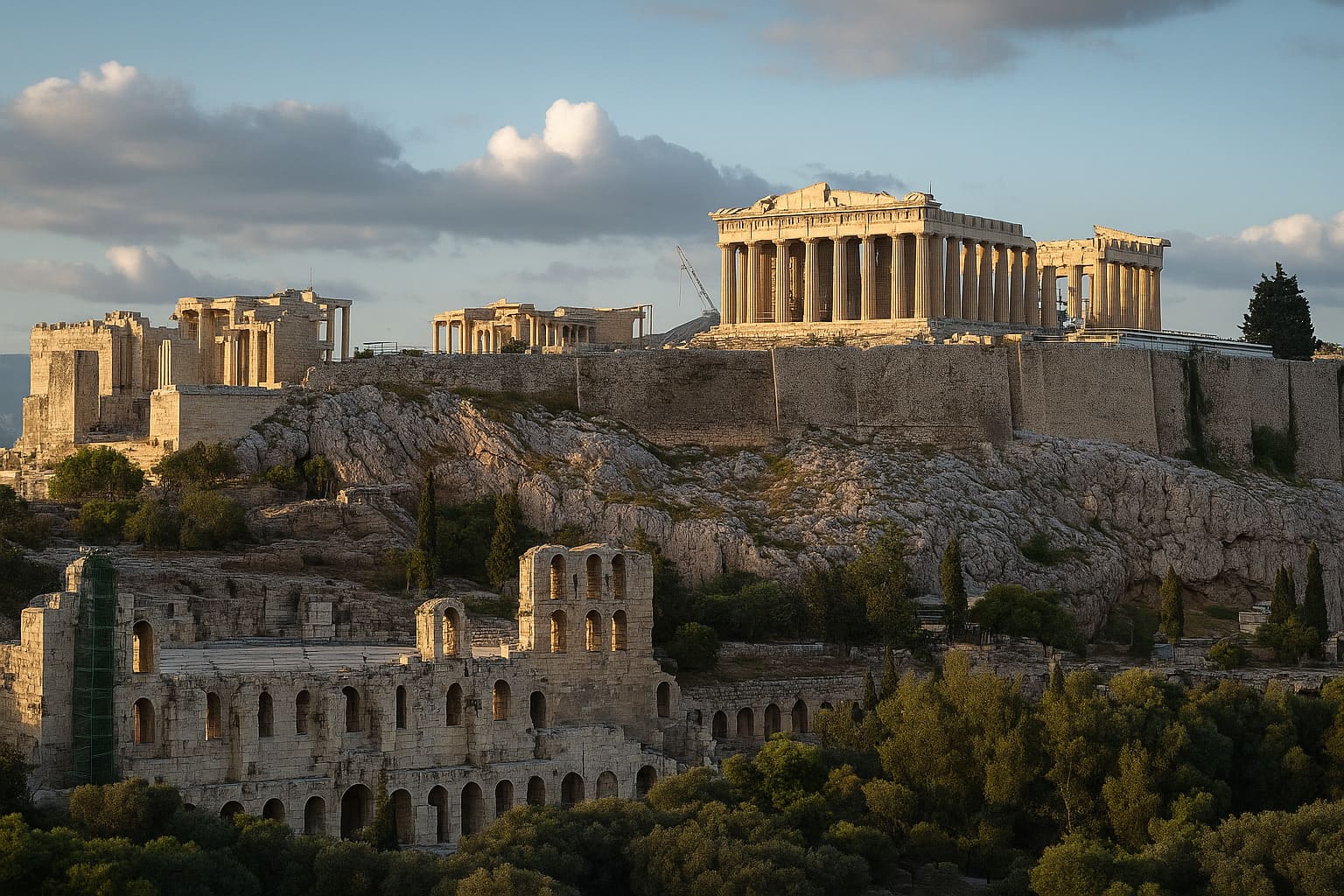
If you’re visiting today, a lot of the stones and inscriptions you see are from this Roman Greece era.
Strategy in a sentence: why Rome won
A helpful one-liner for “did Rome conquer Greece?” is this: Rome fought flexible, well-led campaigns (legions, allies, logistics) against divided, tradition-heavy opponents (phalanx monarchies and rival leagues). The Romans learned, adapted, and kept coming back until resistance collapsed.
A simple story to make it real
Picture a young Athenian artisan around 150 BCE. Trade’s been rough, taxes feel higher, and soldiers pass through more often than his grandfather remembers. He hears that Rome won another victory in the north—and that some cities have chosen the wrong side. In 146 BCE he sees refugees from Corinth. Within a decade, life steadies: Italian merchants buy his wares; a Roman official attends a festival; a Latin inscription appears beside Greek ones at the city gate. He still speaks Greek at home, still watches plays at the theater, but now the coins in his bag carry Roman authority.
That’s what the answer to “did Rome conquer Greece?” looks like on the street.
Key takeaways (mini-conclusions along the way)
- If you need a single year for “did Rome conquer Greece?” use 146 BCE.
- The military pivot was Pydna (168 BCE); the political closure was the destruction of Corinth (146 BCE).
- Rome ruled; Greek culture flourished and influenced the conquerors.
FAQ (quick, clear answers)
When did Rome conquer Greece (in what year)?
The clean headline is 146 BCE, after the Achaean War and the sack of Corinth, when Greece came under direct Roman control.
How did Rome conquer Greece?
Through the Macedonian Wars, finishing with Pydna (168 BCE) and then enforcing authority after the Achaean War (146 BCE). Rome leveraged flexible legions, alliances, and steady logistics.
Why did Rome conquer Greece?
Security in the eastern Mediterranean, obligations to allies, prestige at home, and wealth from trade and tribute.
Did Rome destroy Athens?
No. Athens survived and remained a major cultural center under Roman rule, even as power shifted to Rome.
How long did the Roman Empire last (to place this in time)?
From the late Republic into the Empire and beyond in the East; what matters here is that Roman Greece begins in practice after 146 BCE and continued under imperial administration for centuries.
Final summary
Did Rome conquer Greece?
Yes—after a chain of wars that climaxed with Pydna (168 BCE) and the destruction of Corinth (146 BCE). From 146 BCE onward, Greek cities were under Roman authority, their politics supervised by Roman governors. Yet Greek language, art, and ideas remained central—and profoundly shaped the Roman Empire itself.