Why was the trevi fountain built — the real story, the meaning, and how to see it today
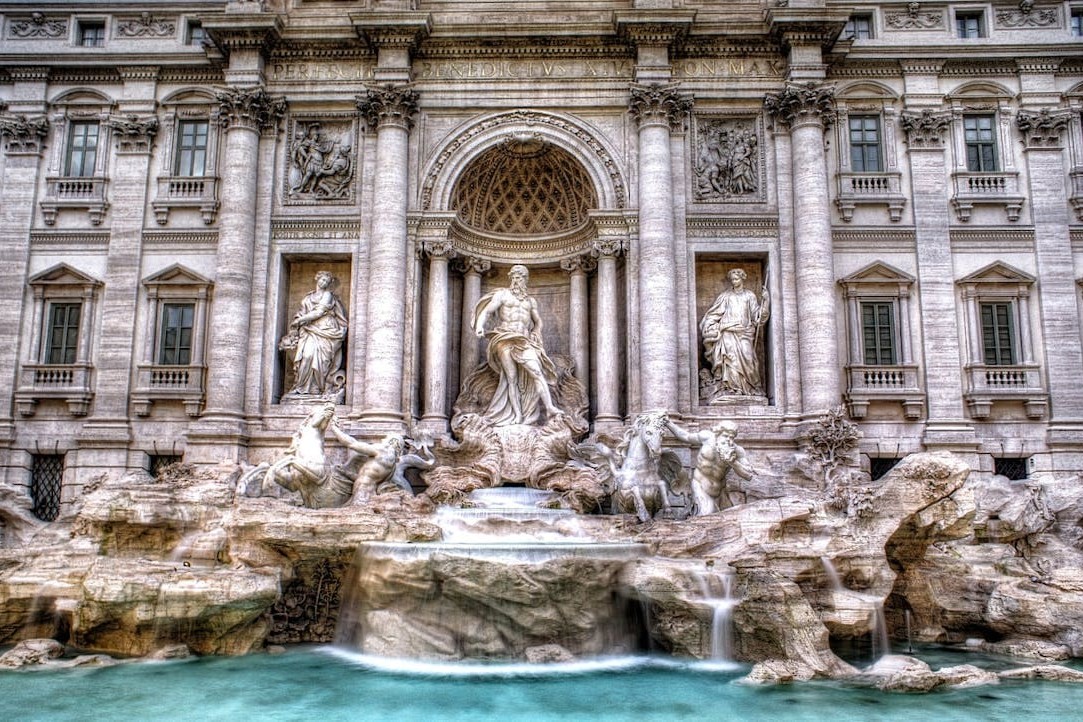
You’re asking why was the Trevi Fountain built. The short answer: it was created to celebrate water and to show it off. More precisely, the Trevi Fountain is a monumental “show fountain” at the end of Rome’s ancient Aqua Virgo (Acqua Vergine) aqueduct. In the 1700s, the popes turned that old water line into a Baroque stage set: a vast marble façade and sculptures where the aqueduct’s clean water could spill into the city in dramatic style. Architect Nicola Salvi won a papal design contest in 1732; the fountain was completed in 1762 by Giuseppe Pannini with the towering figure of Oceanus at the center and allegories of Abundance and Health at the sides. It was both practical (marking the aqueduct’s end) and symbolic (power, prosperity, and pure water for Rome).
Why this fountain, at this spot?
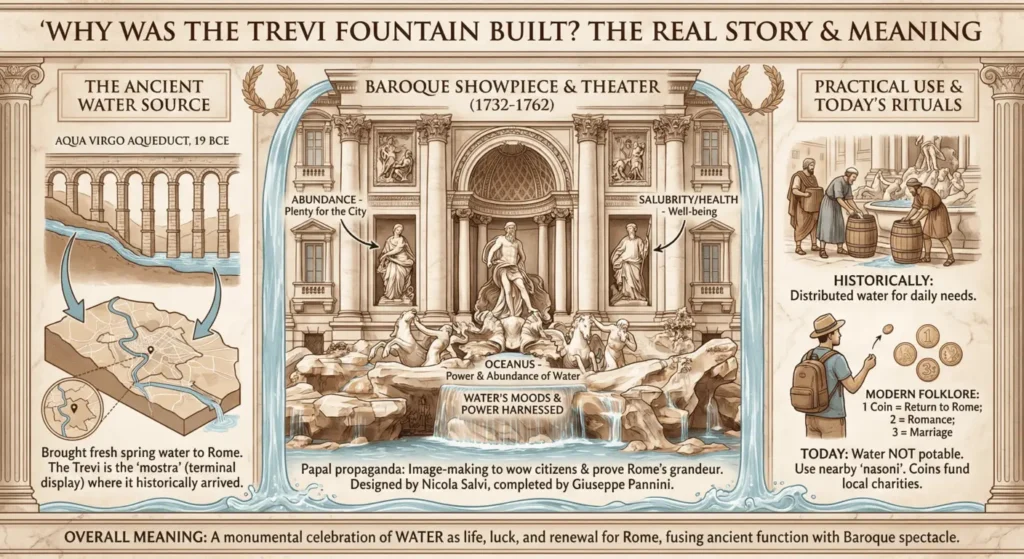
Stand in Piazza di Trevi and look up: the fountain is literally attached to Palazzo Poli. This exact location isn’t random. For over 2,000 years, Aqua Virgo brought spring water underground into the heart of Rome. A “mostra” (display fountain) traditionally marked an aqueduct’s terminal point. The Trevi Fountain is that terminal display. In other words, why was Trevi Fountain built here? Because it’s where the water historically arrived. The Baroque papacy turned a humble end-point into a world-famous stage.
What the iconography means (and how it explains the “why”)
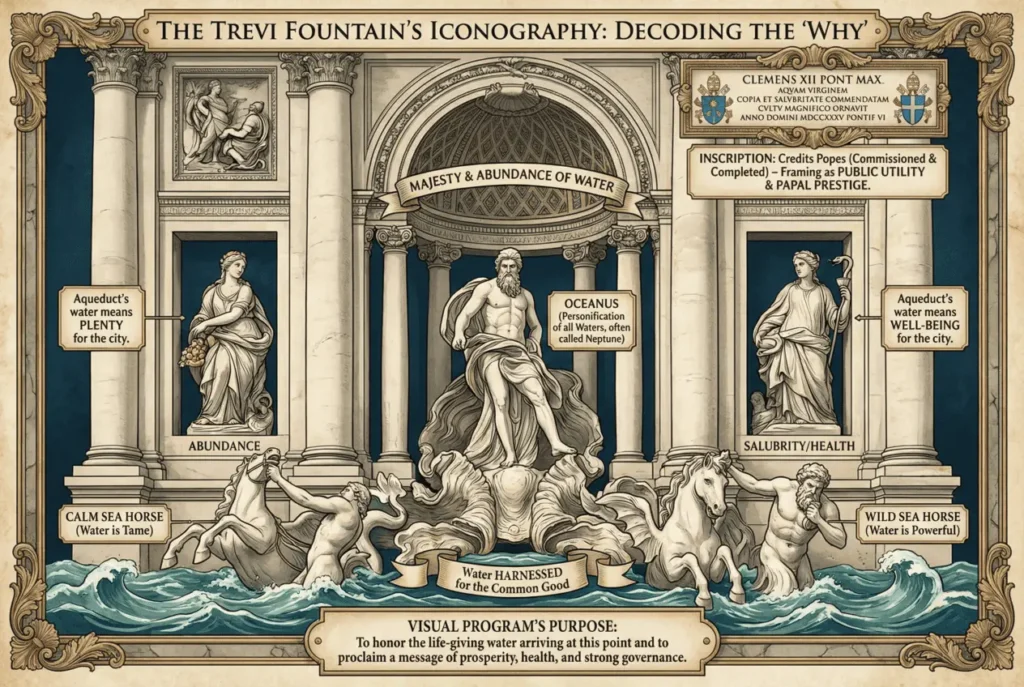
The sculptures aren’t decoration for decoration’s sake. They spell out the fountain’s purpose:
- Oceanus (often called Neptune) stands in the main niche, riding a shell chariot. He represents the majesty and abundance of water.
- To his sides sit Abundance (with a cornucopia) and Salubrity/Health (with a cup and serpent). Those figures make the message crystal clear: the aqueduct’s water means plenty and well-being for the city.
- Tritons and sea horses (one calm, one wild) show how water can be both tame and powerful—yet here, it’s harnessed for the common good.
- Above, the inscription credits the popes who commissioned and completed the fountain, framing it as both public utility and papal prestige.
This visual program answers why was Trevi Fountain built: to honor the life-giving water arriving at this point and to proclaim a message of prosperity, health, and strong governance.
From aqueduct to Baroque showpiece: the timeline in simple steps
You don’t need a PhD in Roman history—here’s the journey in plain language:
- Ancient Rome (19 BCE) – The Aqua Virgo aqueduct, engineered in the age of Augustus, brings fresh water to the city’s center.
- Middle Ages & Renaissance – The aqueduct continues, is repaired, and still serves parts of Rome. The terminal point remains in the Trevi area.
- 18th century re-imagining – Pope Clement XII holds a design competition. Nicola Salvi wins in 1732 with a plan that turns the aqueduct’s end into a theatrical stone scape.
- Completion in 1762 – After Salvi’s death, Giuseppe Pannini finishes the work. The final look—what you see today—cements Trevi as Rome’s greatest Baroque fountain and the city’s most famous “water monument.”
So… was it just a pretty façade, or did Romans actually use it?
Both. In the 1700s, Romans still relied on fountain spouts and troughs for daily needs. A giant “mostra” didn’t only glorify water; it distributed it. Water carriers filled barrels; locals drew from smaller spouts; and the fountain’s pools helped regulate flow. Why was Trevi Fountain built this large? Because it had to do more than look good: it publicized and delivered water.
(Side note for today: modern rules treat the aqueduct water at Trevi as non-potable—don’t drink from the basin. Use nearby public “nasoni” drinking fountains instead.)
Baroque theater as urban branding
If you look closely, Trevi is a theater set. The rock base suggests a natural grotto where water bursts from the earth. The palace serves as the backdrop, like a stage wall. The why is propaganda in the best sense: papal Rome brought order, health, and spectacle to the city. When you ask why was Trevi Fountain built, the answer includes image-making—to wow citizens and visitors and to prove the city could still rival ancient grandeur.
“Was it really Oceanus, or Neptune?” (and why that matters)
Guidebooks vary. Many visitors say “Neptune,” but the figure is often identified as Oceanus, a broader personification of the world’s waters. Either way, the symbolism is the same: the power and abundance of water under the city’s care. For SEO clarity: whether you search Neptune statue Trevi or Oceanus Trevi, you’re chasing the same message that explains why was Trevi Fountain built—to celebrate the Aqua Virgo and Rome’s mastery of water.
How the coin toss fits the story
The coin toss isn’t the reason the fountain was built, but it extends the water = fortune idea. Tossing one coin “guarantees” a return to Rome; two promise romance; three whisper marriage. It’s modern folklore, but it keeps the focus right where it started: water as luck, life, and renewal. (Toss over your right shoulder with your back to the fountain, and don’t climb the marble.)
Planning tips (so you actually enjoy your time there)
- Best times: dawn or late night. You’ll understand the iconography, take photos without the crush, and see the lighting.
- Where to stand: face the Abundance statue (to Oceanus’ left) and you’ll see the agrarian symbols; face Salubrity (to his right) for the health motif—both anchor the “why” of the fountain.
- Respect the site: no feet in the water, no sitting on the statue bases, no drones.
- What to look for: the inscription attributing the work to the popes; the rough travertine rocks meeting smooth architectural lines; the mini-spouts that hint at its practical function.
- Nearby: the Vicus Caprarius archaeological area (nicknamed “City of Water”) lets you see how water shaped this entire district,—a smart add-on if you’re mapping the story behind why was Trevi Fountain built.
Micro-story: a first-timer’s “aha” moment
Picture this: you arrive midday, it’s crowded, and you think, “Nice fountain.” Later, you return at sunrise. You hear the roar before you see it. With only a few people around, the whole façade reads like a book—the Aqua Virgo ending in a burst of white water, Oceanus commanding the flow, Abundance and Health promising a thriving city. That’s when it clicks: why was Trevi Fountain built wasn’t just about decoration—it was Rome reminding you that water made the city possible.
FAQ – Why was the Trevi -fountain built?
Did the Romans build the Trevi Fountain in ancient times?
No. The aqueduct is ancient, but the fountain is 18th-century Baroque. That split—ancient water system, early-modern monument—is key to understanding why was Trevi Fountain built.
Was Trevi meant for drinking water?
Historically, yes—fountains distributed aqueduct water to the public. Today, Trevi’s basin water is not for drinking; use street “nasoni” instead.
Is the central figure Neptune or Oceanus?
Most sources identify Oceanus, but the symbolism overlaps. Either way, it underlines water’s power and abundance.
Why such a dramatic size?
Because the fountain had to represent the aqueduct and deliver water—function plus spectacle.
Who paid for it?
The papal court and municipal authorities of the era. The inscriptions frame it as a civic and papal project tied to the aqueduct’s “mostra.”
What’s unique about Trevi compared to other fountains?
It fuses ancient infrastructure with Baroque theater at the exact point where the aqueduct ends—one reason why was Trevi Fountain built has such a satisfying, place-specific answer.
Summary you can quote
Why was the Trevi Fountain built? To mark the end of the Aqua Virgo aqueduct and to turn a vital water source into Rome’s grand public stage for abundance and health. Designed by Nicola Salvi and completed in 1762 by Giuseppe Pannini, the fountain’s iconography—Oceanus, Abundance, and Health—spells out its purpose: water as the lifeblood of the city, celebrated in unforgettable Baroque stone.