Why is the trevi fountain famous
You’re probably asking why is the trevi fountain famous and whether it’s worth squeezing into your Rome itinerary. Short answer: yes. This famous fountain in Rome blends dramatic Baroque art, a 2,000-year water story, movie stardom, and a feel-good coin throwing ritual that funds charity—making it the single most photographed famous fountain in Italy. Its origins as the endpoint of the ancient Aqua Virgo aqueduct, its monumental sculptures (often mistaken for Neptune but representing Oceanus), and its pop-culture glow explain the hype. For the essentials—history, meaning, tips, and how to visit like a local—read on. (Background and facts from Rome’s official tourism site and Britannica.)
The story that made a fountain legendary
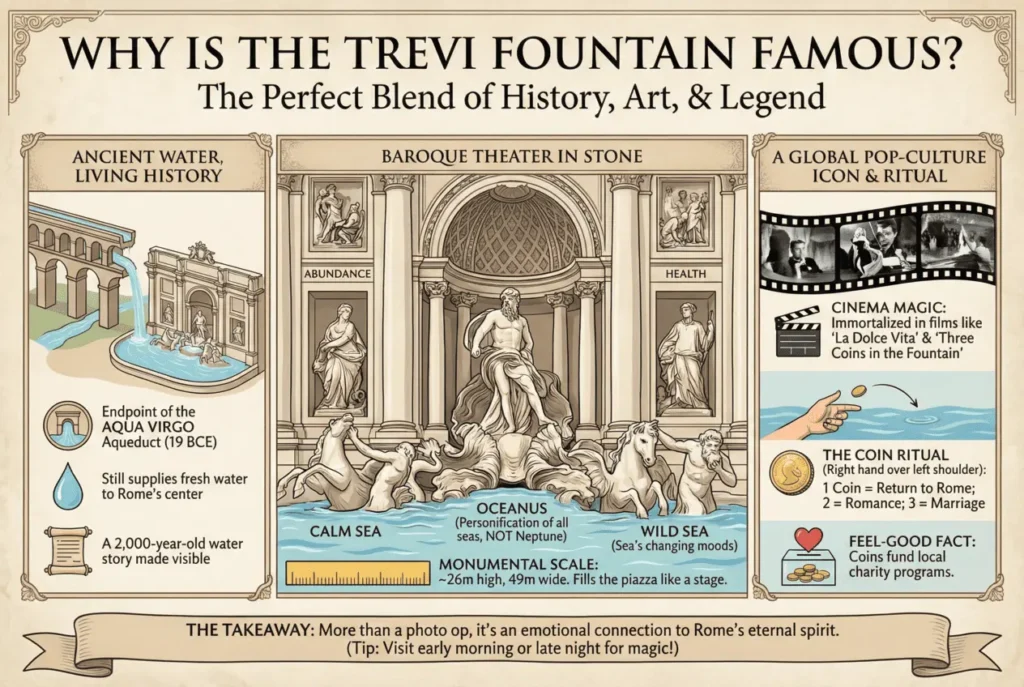
If you want to understand Trevi Fountain history in one line: ancient water + Baroque theater. The spot long marked the terminal of the Aqua Virgo (Aqua Vergine), an aqueduct first completed in 19 BCE to carry clean water into the heart of ancient Rome. In 1732, Pope Clement XII launched a design competition; Nicola Salvi’s dramatic project won and the fountain rose against the façade of Palazzo Poli. After Salvi’s death, Giuseppe Pannini completed it in 1762. Today’s look—cascading travertine cliffs, a shell chariot, rearing sea horses—feels more like open-air stagecraft than a simple Rome fountain.
What you’re actually seeing (and why it matters)
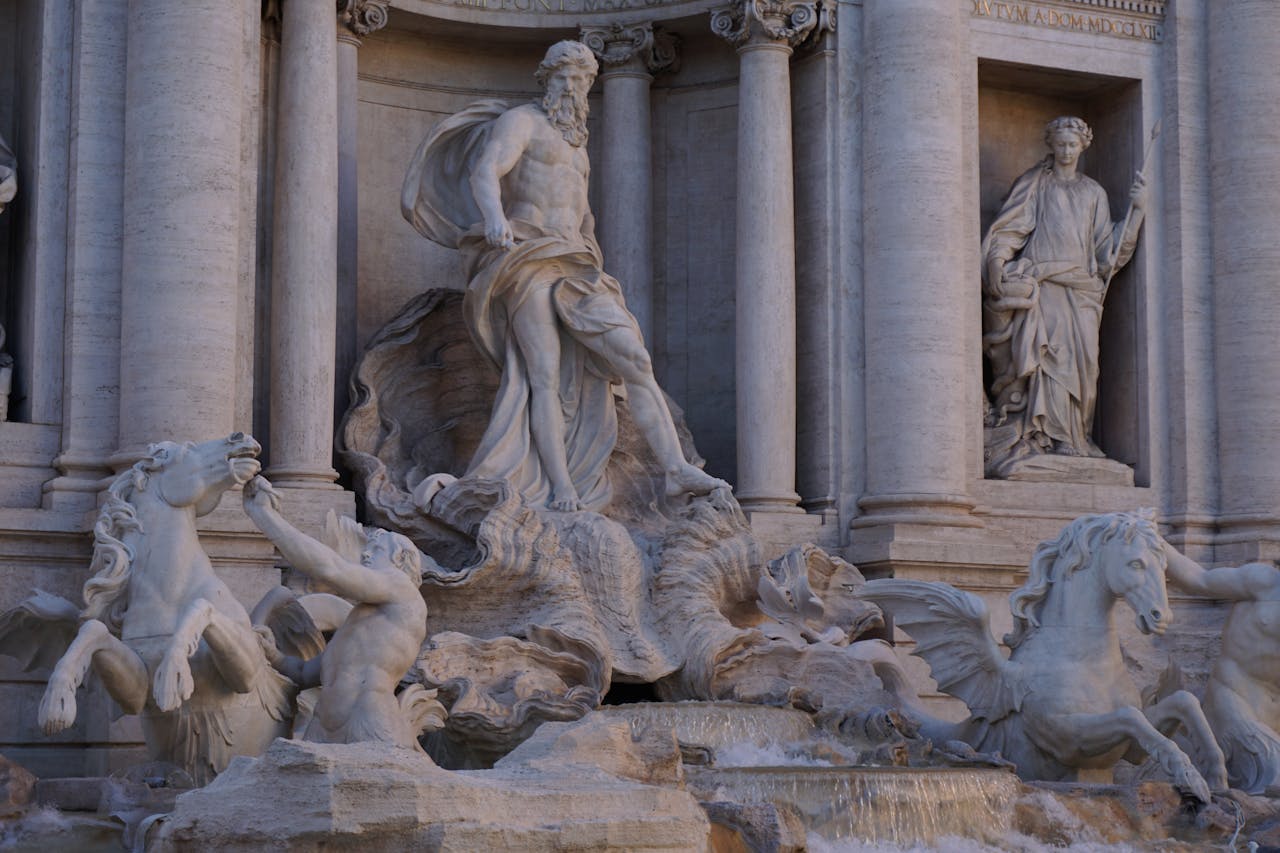
- The central figure is Oceanus (often mistaken for Neptune), riding a shell chariot pulled by two hippocamps—one wild, one calm—led by tritons. That “two horses” contrast symbolizes the sea’s changing moods and, by extension, the fortunes of the city.
- To the sides you’ll spot Abundance and Health/Salubrity, while relief panels above show Agrippa approving the aqueduct and the “virgin” pointing to the spring that inspired the aqueduct’s name.
- Scale matters: the fountain is monumental—about 26 m (85 ft) high and 49 m (161 ft) wide—so it fills the entire piazza and turns water into architecture.
Mini-takeaway: The Trevi isn’t “just pretty.” It’s Rome’s water story made visible, which is why trevi fountain photos always look cinematic—even on a cloudy afternoon.
Lights, camera, Rome: the pop-culture spark
One reason why the Trevi Fountain is famous is its star turn on screen. Fellini’s La Dolce Vita (1960) etched that iconic midnight scene with Anita Ekberg into film history; the earlier Three Coins in the Fountain (1954) popularized the ritual of tossing coins over your shoulder. The fountain also appears in countless music videos and travel campaigns. Pop culture didn’t invent the monument, but it did make the Trevi a global bucket-list moment you feel you already “know” before you ever set foot in Rome.
The coin-throwing ritual (and the good it does)
You’ll see visitors line the balustrade, back to the water, tossing a coin with the right hand over the left shoulder. By tradition:
- One coin: you’ll return to Rome.
- Two coins: you’ll find romance.
- Three coins: you’ll marry.
Here’s the practical beauty of the ritual: coins are collected regularly and directed to social programs through the city’s stewardship—so your wish supports real people. It’s part of the reason many travelers feel emotionally connected to the site and share those trevi fountain photos with a deeper story. (Visiting logistics and the legend are detailed on the city’s official page.)
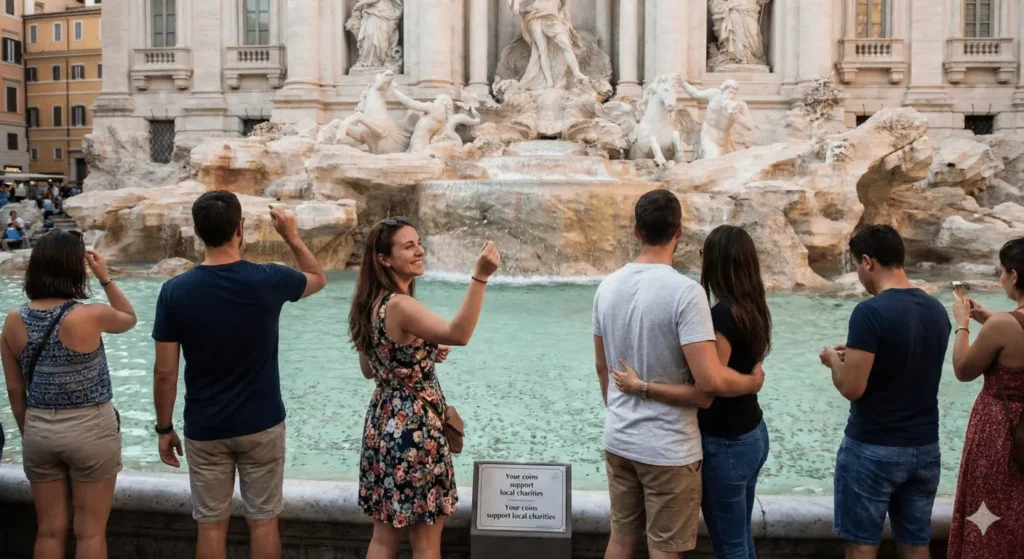
Why is the Trevi Fountain famous? 7 unmissable reasons
- Ancient roots you can still “hear.” The fountain marks the end of an aqueduct still supplying water in Rome’s center. You’re watching a living link to ancient history.
- Baroque drama, carved in stone. The design uses cliffs, columns, and sculpture to choreograph noise, light, and spray. It’s theater—free and outdoors.
- Cultural symbolism that reads at a glance. Oceanus, the horses, and the reliefs are a visual lesson in Rome’s identity—power, order, and abundance.
- Cinema magic. From La Dolce Vita to modern reels, the Trevi is a world-famous set—one more reason it’s the most famous fountain in Rome.
- The coin ritual’s feel-good pull. You participate, not just watch—and your coin does real good via municipal charity channels.
- Scale + setting. The piazza is compact, which makes the fountain feel even larger; turn a corner and it suddenly explodes into view.
- It evolves yet stays “Eternal.” Recent restorations (including a major one in the 2010s) keep the marble bright while preserving its historic look.
When to go and how to get the best view
You asked for real-world advice, not just poetry. Here’s how to plan your moment:
- Best time of day: sunrise to mid-morning or late night (after 21:00). Crowds thin, and the water glows under lights.
- Where to stand: the balustrade directly facing Oceanus gives the classic shot; a slight angle from the right lets you include Palazzo Poli in frame.
- Protect your stuff: the piazza can be tight. Keep valuables close in a crossbody bag.
- Respect the rules: no sitting on the edge or entering the water (fines apply). As of 2026, Rome plans a small perimeter access fee at certain times; always check the city page before you go.
What the details tell you (if you slow down)
Take 10 minutes to read the façade like a story:
- Left relief: the young woman (the “virgin”) shows Roman soldiers the spring—this is the origin tale of the aqueduct supplying the fountain.
- Right relief: Agrippa (yes, the one behind the Pantheon you’ll visit later) authorizes construction—statecraft and service in stone.
- Side statues: Abundance holds a cornucopia; Health/Salubrity rests on a serpent-handled cup.
- Oceanus vs. Neptune: guides and captions sometimes call him Neptune, but the official iconography is Oceanus, the personification of all waters. That subtlety matters—it makes the scene an allegory for Rome’s mastery of water, not sea conquest.
A short timeline (so you can explain it at dinner)
- 19 BCE: Aqua Virgo brings fresh water to Rome’s Campus Martius.
- 12th–16th centuries: the area is known as “Tre Vie” (“three streets”)—the name sticks.
- 1732: Nicola Salvi wins the papal competition to design a monumental fountain at the aqueduct’s end.
- 1762: Giuseppe Pannini completes the project.
- 20th century: cinema puts the Trevi on millions of screens.
- Recent decades: restoration campaigns keep the travertine bright; visiting rules evolve with crowd management. (Historic and size references corroborated by Britannica.)
Practical tips: make your wish count
- Bring a small coin. The amount doesn’t matter; the gesture does. Toss with your right hand over your left shoulder for tradition’s sake.
- Photo etiquette: take the shot, then step back so others can reach the rail.
- Night vs. day: daylight shows off the sculpture; nighttime adds glow and fewer people. Do both if your schedule allows.
- Pair it with nearby sights: walk five minutes to the Spanish Steps or through the Centro Storico for gelato.
- Weather check: Rome can be hot in summer; early morning gives you better light and cooler air for those trevi fountain photos.
Tiny myths, quick truths
“Was Rome built in a day?” Of course not—just as the Trevi took decades and generations. Seeing it reminds you that great things take time.
“Is it a temple to Neptune?” Close, but not quite. Oceanus stands at the center; Neptune shows up elsewhere in the city. That common mix-up explains why many captions vary.
“Is it only a tourist trap?” Go at dawn, listen to the water, and read the reliefs. You’ll feel the ancient Rome story under the selfie sticks.
A traveler’s moment (story time)
I once heard a dad explain the scene to his kid like a comic strip: “That girl found the spring; that general said ‘build it’; the big guy is the ocean; the angry horse is a storm; the calm horse is a quiet day.” The kid nodded, flipped a coin, and whispered, “see you soon, Rome.” That’s the Trevi’s magic. You don’t need a doctorate to get it—you feel it.
FAQ
Why is the Trevi Fountain famous?
Because it fuses live water from an ancient aqueduct with massive Baroque sculpture, a beloved coin-throwing ritual, and global film moments—making it the most famous fountain in Italy.
Is the Trevi Fountain free?
Viewing is free from the piazza; authorities manage access to the inner perimeter and schedule maintenance/collections. Check the official page for current rules.
When is the best time to visit?
Early morning or late evening for fewer crowds and better photos.
What happens to the coins?
They’re collected and used to support social programs via Rome’s management—so your wish helps locals.
How big is it?
Roughly 26 m high and 49 m wide—one reason it overwhelms the square.
Can I take professional pictures or a tripod?
Tripods and filming often require permits; casual photos are fine. Be respectful of space and security.
Wrap-up you can copy into your notes
why is the trevi fountain famous? Because it’s where ancient engineering meets Baroque art, amplified by cinema and a charitable ritual you can join in seconds. If you only have one evening left in Rome, make it the Trevi: arrive early or late, toss one coin, take a breath, and let the city’s oldest water story wash over you.