 Colosseum at Night
 EN
EN DE
DE ES
ES FR
FR IT
ITSt. Peter's Basilica was built between 1506 and 1626. Pope Julius II laid the foundation stone on 18 April 1506, and Pope Urban VIII consecrated the finished church on 18 November 1626, about 120 years later. It replaced Old St. Peter's, a basilica begun by Emperor Constantine around AD 320 over the tomb of St. Peter in Vatican City.
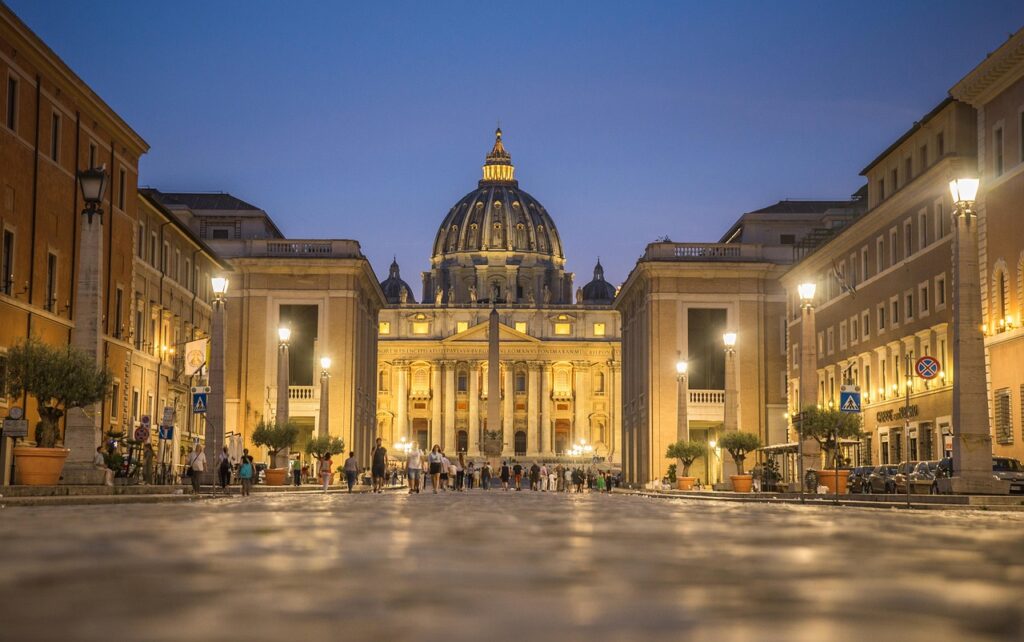
Those 120 years saw the High Renaissance turn into the Baroque. More than a dozen popes and at least seven major architects came and went, along with the Protestant Reformation and the Sack of Rome. Here is how the world's most famous church was actually built, who designed which part, and why it took so long.
What Is St. Peter's Basilica, and Where Is It?
St. Peter's Basilica (Basilica di San Pietro) is the principal church of the Catholic Church's papacy and one of the four papal major basilicas of Rome. It stands on Piazza San Pietro in Vatican City, the independent city-state inside Rome on the west bank of the Tiber. If you are wondering how close that is to the centre, our guide to how far Vatican City is from Rome has the walking and metro times.
Two things surprise many visitors. First, St. Peter's is not the cathedral of Rome. That title belongs to St. John Lateran, the pope's official seat as Bishop of Rome. Second, the basilica is built on a burial site. According to tradition, the apostle Peter was martyred near Nero's circus in the 60s AD and buried on the slope of the Vatican Hill. The Fabbrica di San Pietro, which runs the basilica, places his tomb directly beneath the high altar.
Before 1506: Old St. Peter's
The first church on the site was commissioned by Constantine, the first Christian emperor. Work began around AD 320, and tradition says Pope Sylvester I dedicated the basilica on 18 November 326. Its long nave and four rows of columns made it one of the largest buildings in the Christian world, and for more than a thousand years it was the goal of pilgrims from all over Europe. Charlemagne was crowned emperor there on Christmas Day 800.
By the 1400s, though, the old basilica was more than 1,100 years old and visibly failing, with leaning walls and patched roofs. Several popes discussed rebuilding it. In 1505 Pope Julius II made the radical decision: tear it down and start again.
The 120-Year Build: A Timeline
| Year | Milestone |
|---|---|
| c. 320–326 | Constantine builds Old St. Peter's over the apostle's tomb |
| 18 April 1506 | Julius II lays the first stone of the new basilica; Bramante is architect |
| 1514 | Bramante dies; Raphael and others take over |
| 1517 | Indulgence sales for the building help spark Luther's Reformation |
| 1527 | The Sack of Rome halts construction for years |
| 1546 | Michelangelo, aged 71, becomes chief architect |
| 1564 | Michelangelo dies; the dome is built only up to the drum |
| 1588–1590 | Giacomo della Porta and Domenico Fontana raise the dome in 22 months |
| 1607–1614 | Carlo Maderno lengthens the nave and builds the façade |
| 1624–1633 | Bernini's bronze baldacchino rises over the high altar |
| 18 November 1626 | Pope Urban VIII consecrates the new basilica |
| 1656–1667 | Bernini designs and builds St. Peter's Square with its colonnade |
Who Designed St. Peter's Basilica?
No single architect designed St. Peter's. It is a relay race, and each runner changed the route.
Bramante's grand plan (1506–1514)
Donato Bramante imagined a perfectly symmetrical church in the shape of a Greek cross, with four equal arms under a vast central dome. He started the four giant piers that still carry the dome today. He also earned the nickname "Bramante the wrecker" for how much of the old basilica he demolished.
Raphael, Sangallo and the lost decades (1514–1546)
After Bramante's death, Raphael took charge and redrew the plan as a Latin cross with a long nave. He died in 1520. Baldassare Peruzzi and Antonio da Sangallo the Younger followed, each with a new design, and Sangallo even built a huge wooden model. Then the 1527 Sack of Rome stopped the work, and regular building only resumed around 1540. After four decades, the new basilica was still a building site.
Michelangelo's dome (1546–1564)
In 1546 Pope Paul III appointed Michelangelo, then 71 years old. He scrapped Sangallo's plan and returned to a compact central design close to Bramante's, which made the building stronger and cheaper. Above all, he designed the dome. Michelangelo worked on St. Peter's without pay until his death in 1564, by which time the drum, the round base of the dome, was finished.
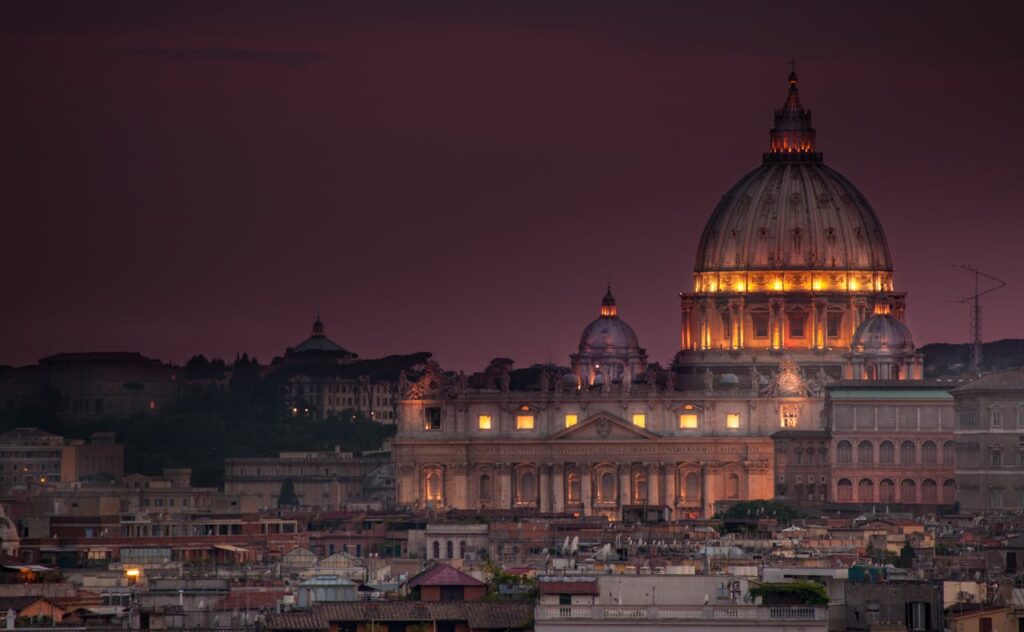
Della Porta and Fontana finish the dome (1588–1590)
Under Pope Sixtus V, Giacomo della Porta and Domenico Fontana completed the dome in just 22 months, giving it a slightly taller profile than Michelangelo's drawings. The gilded bronze ball and cross were placed on top of the lantern on 18 November 1593.
Maderno's nave and façade (1607–1614)
Pope Paul V wanted a church big enough for vast congregations, and one that covered the full footprint of the old basilica. Carlo Maderno extended the nave, turning Michelangelo's central plan into a Latin cross after all. He also built the 116-metre-wide façade, whose inscription is dated 1612. The trade-off is still visible today: from the square, the long nave hides much of Michelangelo's dome.
Bernini's finishing touches (1624–1667)
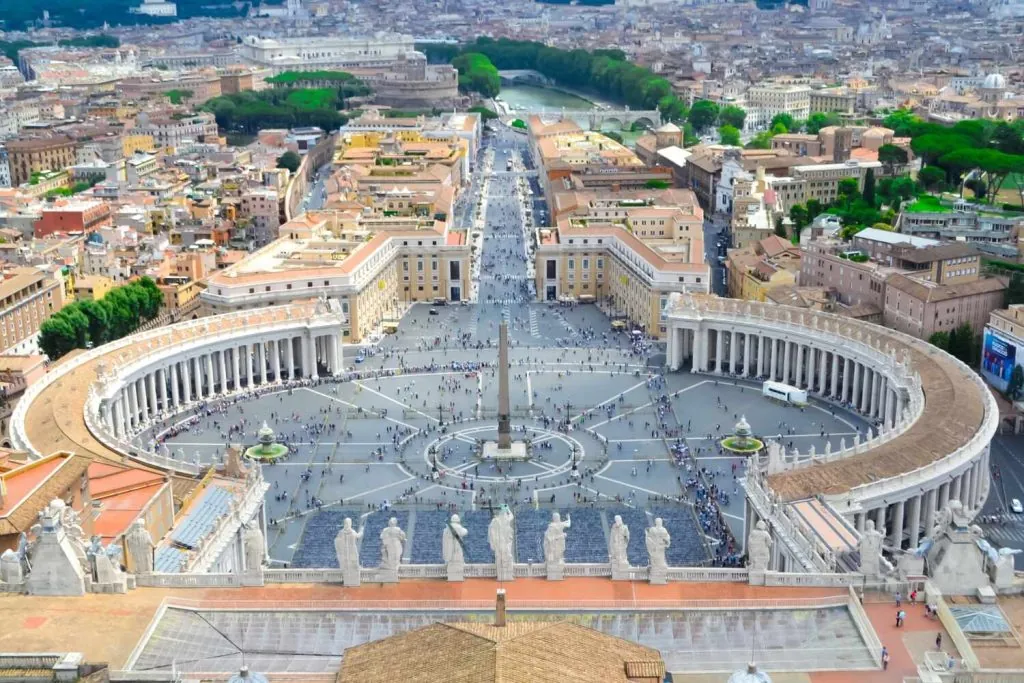
The young Gian Lorenzo Bernini gave St. Peter's its Baroque soul. He built the bronze baldacchino over the papal altar (1624–1633), restored in 2024 for the first time in about 250 years. He went on to design St. Peter's Square (1656–1667), whose two curving colonnades, with 284 columns and 140 statues, reach out to visitors "like the motherly arms of the Church."
Why Did St. Peter's Take 120 Years to Build?
Four things slowed it down:
- Constant redesigns. Greek cross or Latin cross? Every new architect and every new pope had an opinion, and the plan flipped at least three times.
- Deaths. Bramante, Raphael, Peruzzi, Sangallo and Michelangelo all died with the building unfinished.
- War. The Sack of Rome in 1527 by the troops of Emperor Charles V stopped work and emptied the papal treasury.
- Money. The cost was enormous. To pay for it, Pope Leo X authorised an indulgence campaign whose proceeds were partly sent to Rome for the basilica. The preacher Johann Tetzel's sales in Germany provoked Martin Luther to publish his 95 Theses in 1517. In that sense, the building of St. Peter's helped split Western Christianity.
Rome also recycled its past to save money. Some of the travertine used in St. Peter's was taken from the ruins of the Colosseum, one of the reasons the amphitheatre looks the way it does today, as we explain in what happened to the Colosseum.
St. Peter's Basilica by the Numbers
| Measure | Figure |
|---|---|
| Interior length | about 186 m (611 ft) |
| Total length incl. portico | about 220 m (720 ft) |
| Interior area | about 15,160 m² |
| Height to the top of the cross | about 133 m per the Fabbrica; 136.6 m is often quoted |
| Inner diameter of the dome | about 41.5 m (136 ft) |
| Façade | 116 m wide, 45.5 m high |
| Capacity | roughly 20,000 people inside |
St. Peter's is usually described as the largest church in the world by interior size. The Basilica of Our Lady of Peace in Yamoussoukro, Ivory Coast, sometimes claims the title, but its figure includes the surrounding buildings and grounds.
Three November 18ths: 326, 1626 and 2026
Here is a detail most guides miss. Old St. Peter's was traditionally dedicated on 18 November 326. Urban VIII deliberately consecrated the new basilica on the same date in 1626, exactly 1,300 years later. And on 18 November 2026 the basilica marks its 400th anniversary, closing a year-long programme of events with a Mass celebrated by Pope Leo XIV.
If you visit in late 2026, you are seeing the building in its anniversary year. Its story stretches from Constantine to the present, which is exactly why Rome earned the name the Eternal City.
Visiting Today: The Essentials
- Entry. Free. Since 1 June 2026 the basilica is open daily from 7 am to 8 pm (last entry 7:15 pm), according to the official site. Expect a security queue.
- Dress code. Covered shoulders and knees; staff turn people away at the door. See [what to wear in Rome](/what-to-wear-in-rome/).
- The dome climb. There is a fee. Even with the lift you still climb over 300 steps to the lantern, for the view shown above.
- Don't miss. Michelangelo's *Pietà* (1498–1499), carved when he was 23 and the only work he ever signed, just inside on the right.
- Getting there. Metro Line A to Ottaviano, then about a 10-minute walk.
Planning your days around it? Our guide to how many days you need in Rome shows where the Vatican fits. If you prefer to see it with an expert, compare the guided options in our best tours in Rome.
Frequently Asked Questions
How long did it take to build St. Peter's Basilica?
Who designed St. Peter's Basilica?
How old is St. Peter's Basilica?
Is St. Peter buried under St. Peter's Basilica?
Is St. Peter's Basilica in Rome or Vatican City?

Founder of PortalWeb GmbH, a Swiss web agency, and a passionate traveler. Every fact on Colosseum at Night is checked against official sources and kept up to date.
Comments