
On this page · 8 sections
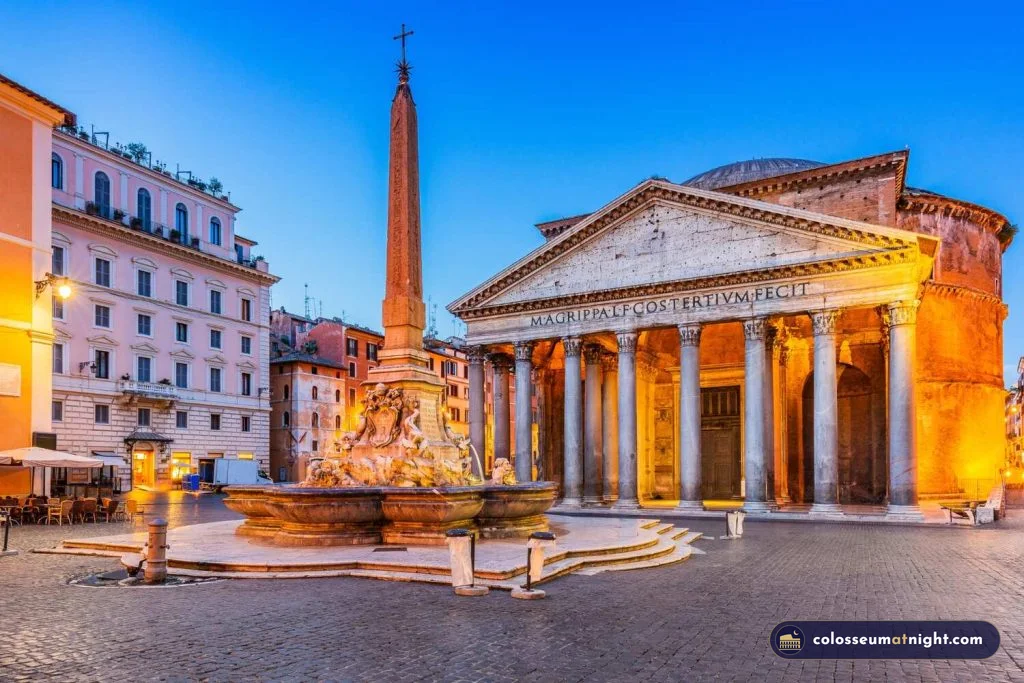
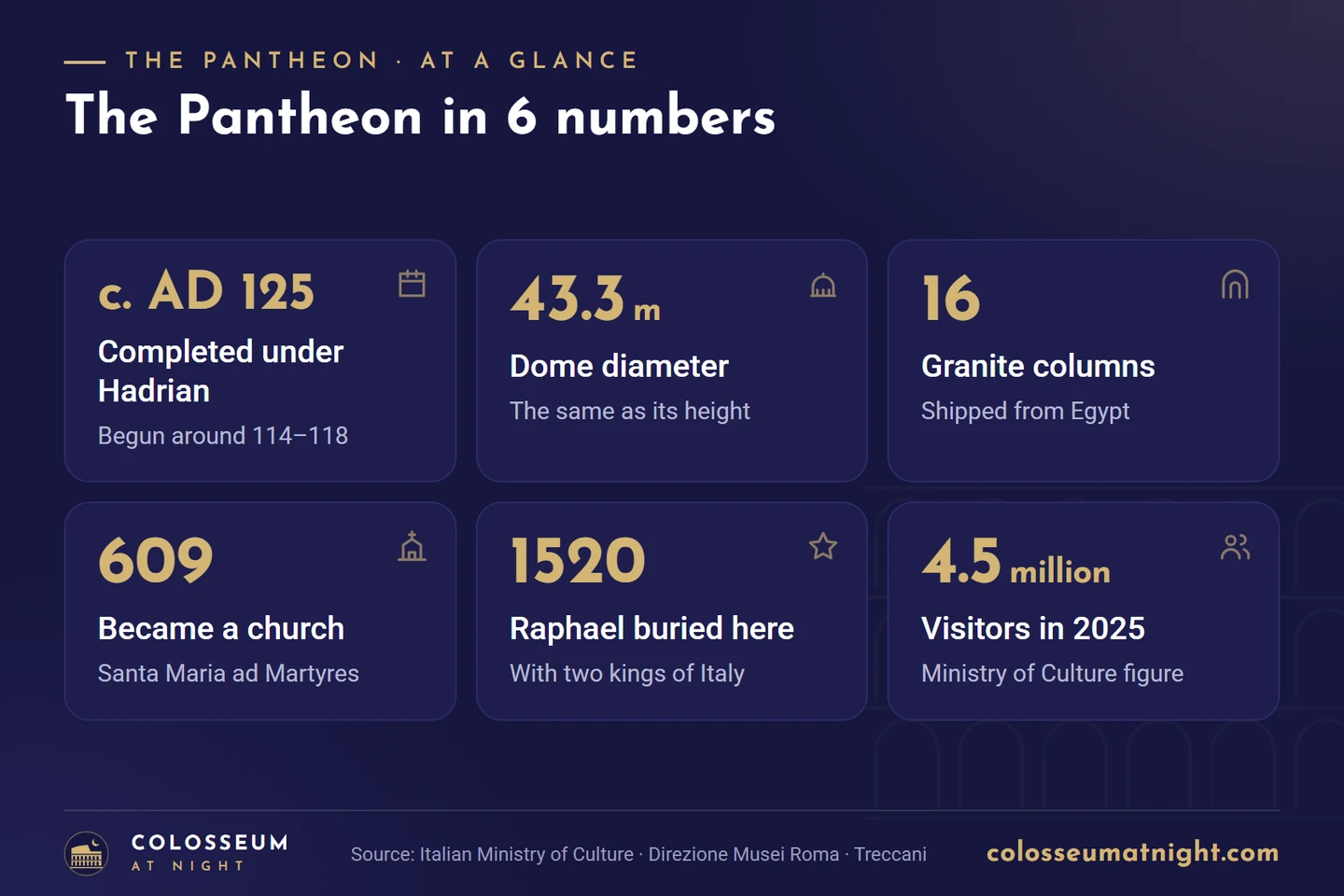
The Pantheon is an ancient Roman temple in the centre of Rome, Italy, and one of the best-preserved buildings of the ancient world. Today's building was completed under Emperor Hadrian around AD 125, on the site of a temple built by Marcus Agrippa in 27–25 BC. It has been a church since 609, and entry costs €7.
Almost 1,900 years after Hadrian's builders finished it, the Pantheon still stands under its original concrete roof, which Italy's Ministry of Culture describes as the largest unreinforced dome ever built. Below you will find what the Pantheon is, who built it, what it was used for, how the dome works, who is buried inside and what you need to know about tickets in 2026.
What Is the Pantheon?
The Pantheon is a round temple with a deep columned porch, standing on Piazza della Rotonda in Rome's historic centre. Its name comes from the Greek for "all the gods", and the traditional story is that it honoured the whole Roman pantheon. In reality nobody knows its exact dedication. According to Italy's Ministry of Culture, it first honoured Augustus and then the gods of his family, and even the ancient historian Cassius Dio could only guess why it was called the Pantheon.
The building has three parts: a portico with 16 granite columns, a tall block that links it to the main hall, and the rotunda itself, crowned by the dome. Since 609 it has been a Catholic church, the Basilica of Santa Maria ad Martyres, and it is one of the most visited monuments in Italy, with about 4.5 million visitors in 2025.
Who Built the Pantheon?
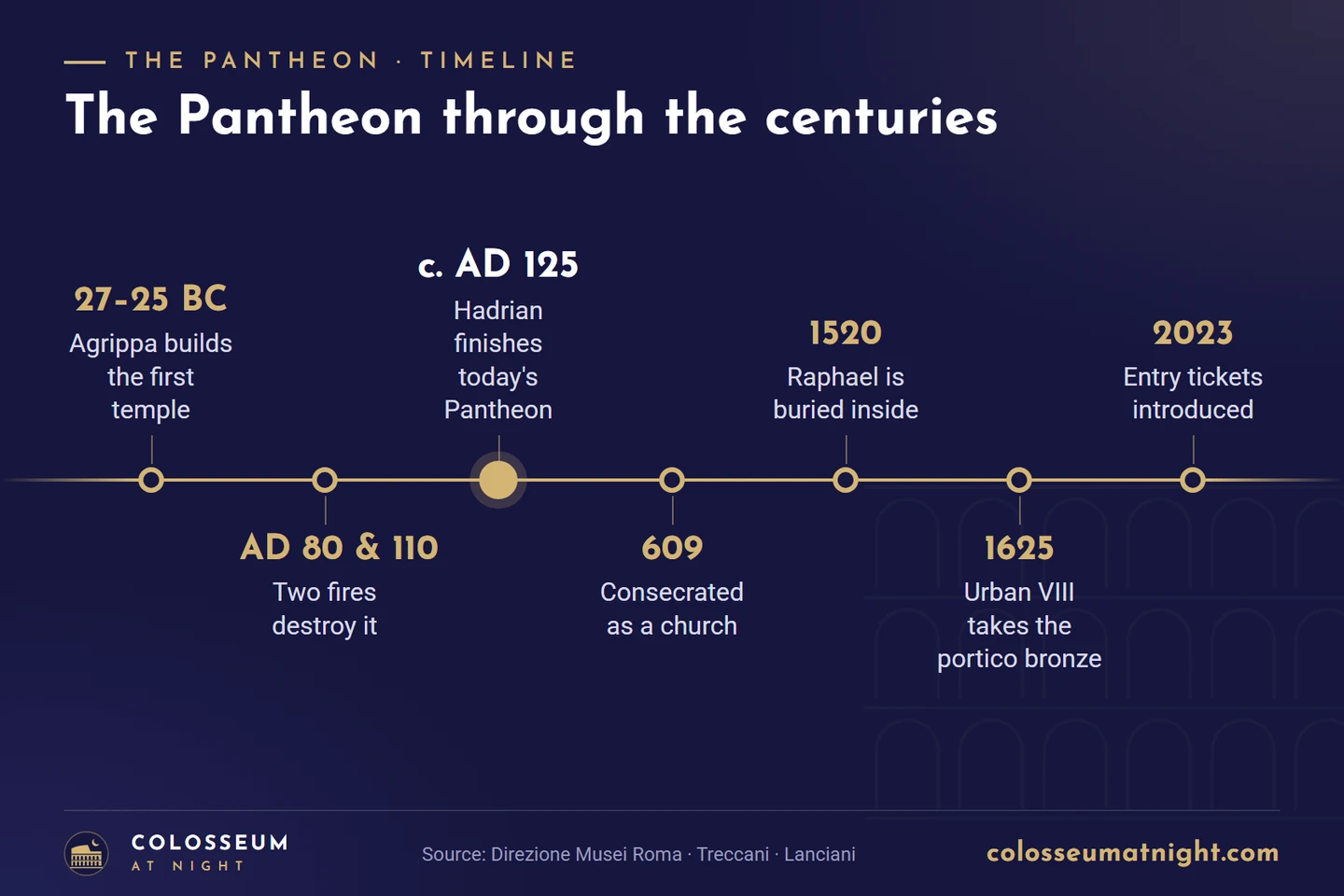
The first Pantheon was built by Marcus Agrippa, the friend, general and son-in-law of Augustus, in 27–25 BC. Agrippa's temple burned in AD 80 and was rebuilt by Emperor Domitian, then burned again in AD 110.
The building you see today was built under Emperor Hadrian. The official dating is AD 118–125, but stamps on the bricks suggest work may already have started under Trajan, around 114–116. The safest summary is that it was begun between about 114 and 118 and completed around 125. You can read more about Agrippa's patron in our guide to the first emperor of Rome.
Hadrian did something unusual: instead of putting his own name on the façade, he kept Agrippa's. The bronze letters read M·AGRIPPA·L·F·COS·TERTIVM·FECIT, short for "Marcus Agrippa, son of Lucius, consul for the third time, made this". A smaller line underneath records a restoration under Septimius Severus in AD 202.
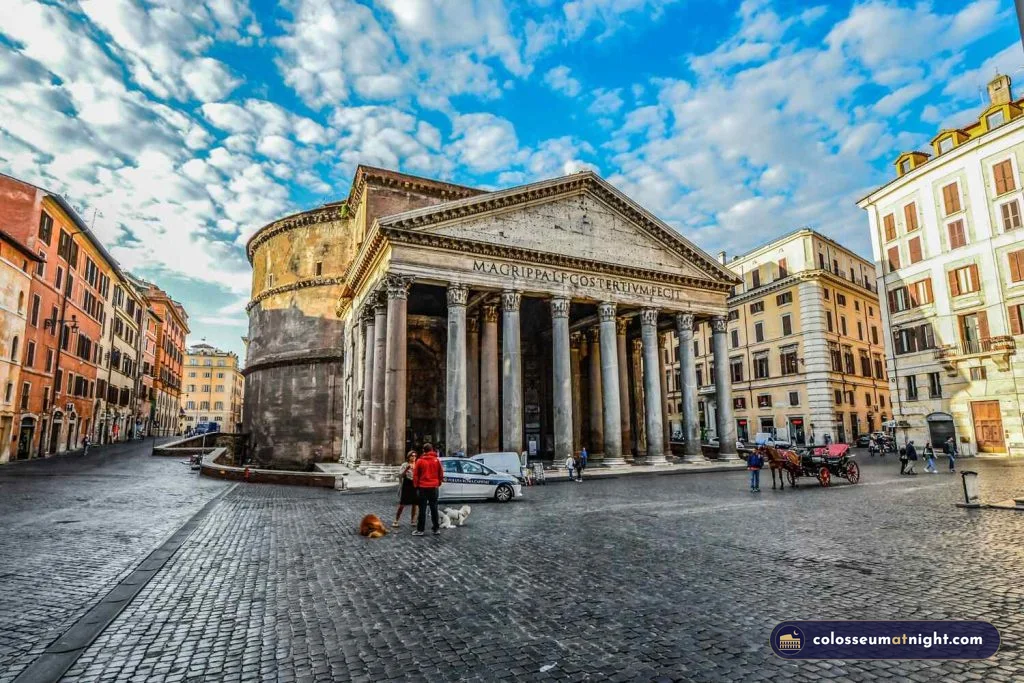
The 16 columns of the portico are single blocks of Egyptian granite, grey stone from Mons Claudianus and pink stone from Aswan, each about 11.9 metres (39 feet) tall. Eight stand at the front, with two rows of four behind. Look closely at the left side: three of those columns were replaced in the 1600s.
The Pantheon in a short timeline
| Year | What happened |
|---|---|
| 27–25 BC | Marcus Agrippa builds the first Pantheon |
| AD 80 | Fire destroys it; Domitian rebuilds it |
| AD 110 | A second fire destroys the building |
| c. 114–125 | Today's Pantheon is built and completed under Hadrian |
| 13 May 609 | Pope Boniface IV consecrates it as the church of Santa Maria ad Martyres |
| 663 | Emperor Constans II strips the gilded bronze roof tiles |
| 1520 | The painter Raphael is buried inside |
| 1625–1626 | Pope Urban VIII removes the bronze roof truss of the portico |
| 1878 | Victor Emmanuel II, the first king of united Italy, is buried here |
| 3 July 2023 | Entry tickets are introduced |
| 1 July 2026 | The full ticket rises from €5 to €7 |
What Was the Pantheon Used For?
For its first five centuries the Pantheon was a temple. In 609, the Byzantine emperor Phocas gave it to Pope Boniface IV, who consecrated it on 13 May as a church dedicated to the Virgin Mary and the martyrs. This is the same Phocas who is honoured by the last monument ever raised in the Roman Forum, as we explain in how long Rome lasted.
Becoming a church saved the building. While other ancient temples were quarried for stone, the Pantheon stayed in use and was maintained. That does not mean it was left untouched: in 663 Emperor Constans II carried off its gilded bronze roof tiles, and in 1625–1626 Pope Urban VIII, a member of the Barberini family, took the bronze beams of the portico roof. His own physician joked about it, and the joke later became a famous Latin line: Quod non fecerunt barbari, fecerunt Barberini, "what the barbarians did not do, the Barberini did".
A popular story says this bronze was used for Bernini's canopy in St Peter's Basilica. Papal accounts studied by the archaeologist Rodolfo Lanciani show that most of it was cast into 80 cannons for Castel Sant'Angelo instead.
The Pantheon is still a working church today. Mass is held on Saturdays at 17:00 and on Sundays at 10:30. On Pentecost Sunday, after the morning Mass, firefighters drop red rose petals through the opening in the dome, a tradition that draws big crowds.
How Does the Pantheon's Dome Work?
The dome is the reason architects still travel to see the Pantheon. Its inner diameter is 43.3 metres (142 feet), exactly the same as the height from the floor to the top. That means a perfect sphere would fit inside the building, touching the floor.
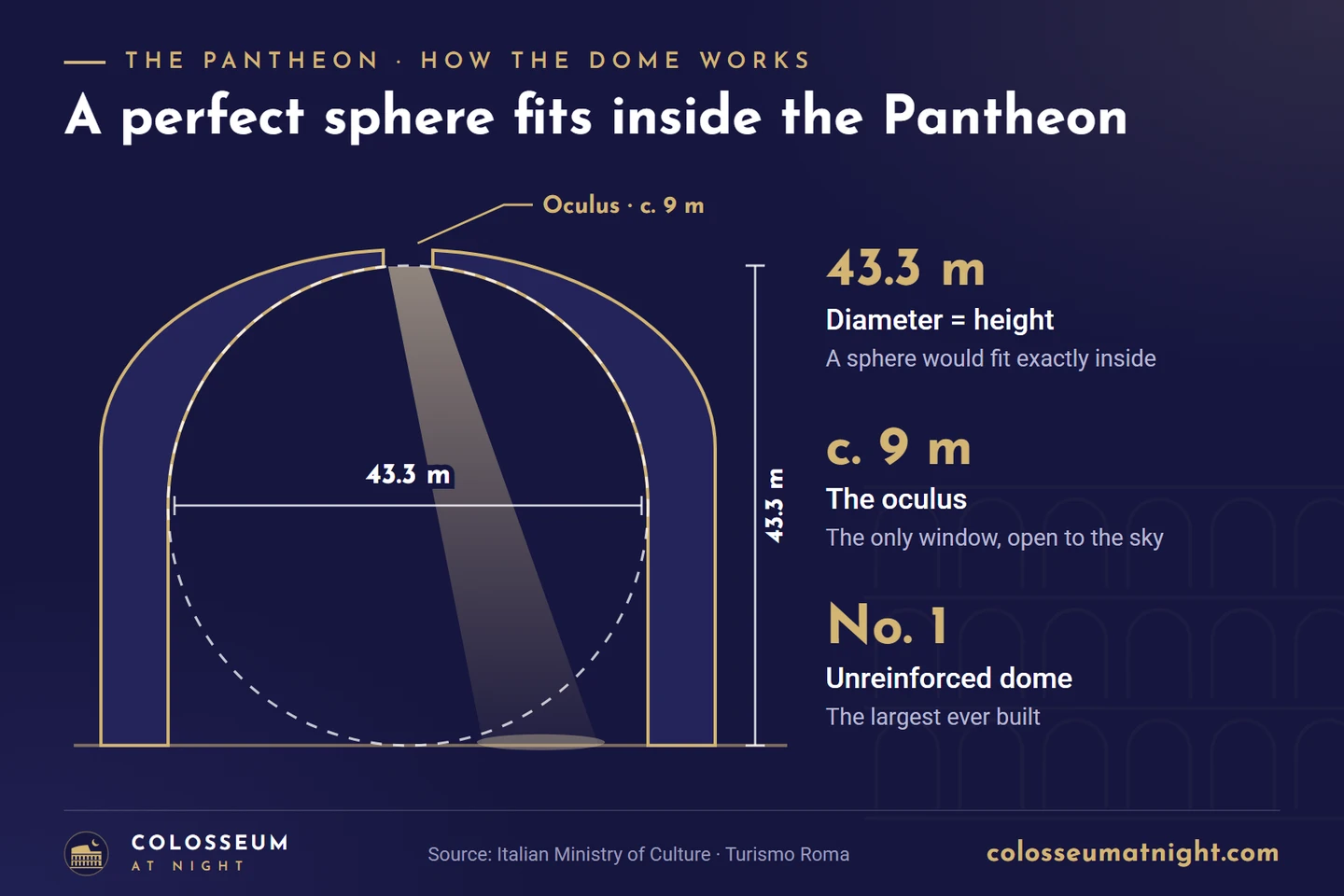
The Romans built it from concrete, without any steel reinforcement, and made it lighter towards the top. The shell is about 6 metres thick at the base and much thinner near the summit, and the sunken square panels on the inside, the coffers, arranged in five rings of 28, remove more weight.
At the very top is the oculus, an open circle about 9 metres (29 feet) wide. It is the building's only window, and the sunlight it lets in moves across the walls through the day like a giant sundial. It is also open to the weather. Rain does fall inside: the marble floor is slightly domed and has 22 small drain holes that carry the water away. If it rains during your visit, you get to watch it happen.
Who Is Buried in the Pantheon?
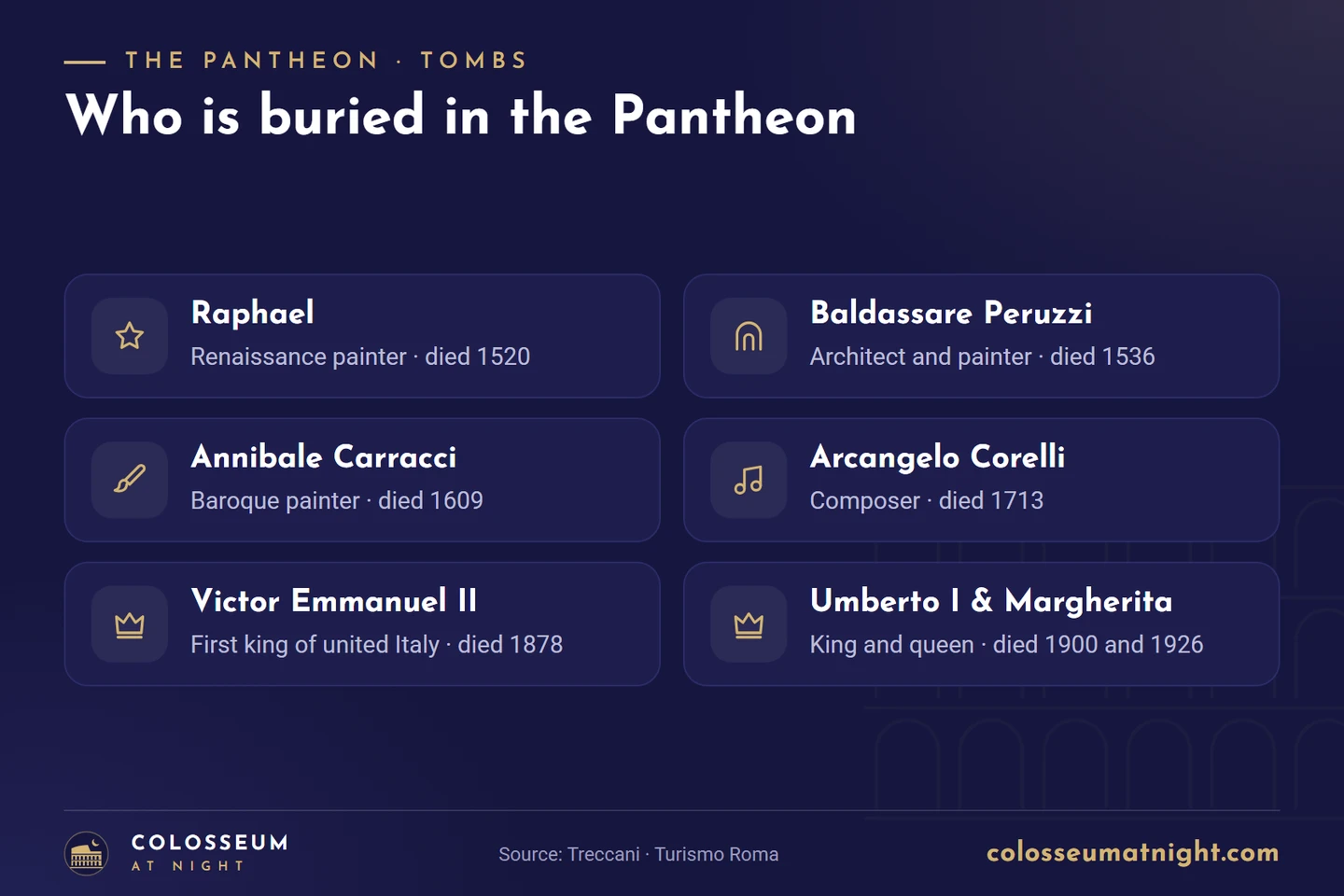
The Pantheon is also a resting place for some of Italy's most famous artists and two of its kings:
- Raphael. , the Renaissance painter, died on 6 April 1520 and was buried the next day in a tomb he had chosen inside the Pantheon.
- Baldassare Peruzzi. , architect and painter, was buried beside Raphael in 1536.
- Annibale Carracci. , the painter, was buried here at his own wish in 1609.
- Arcangelo Corelli. , the baroque composer, died in 1713 and is buried in the Pantheon.
- Victor Emmanuel II. , the first king of united Italy, died on 9 January 1878.
- Umberto I. , his son, was assassinated in 1900, and his wife, Queen Margherita, died in 1926. Both rest in the Pantheon.
Do You Need Tickets for the Pantheon?
Yes. Since 3 July 2023 you need a ticket to enter the Pantheon, and on 1 July 2026 the full price rose from €5 to €7. Two euros of each full ticket help fund neighbourhood libraries in deprived and inland areas of Italy.
| Pantheon tickets and hours 2026 | |
|---|---|
| Full ticket | €7 |
| Reduced ticket | €2 for EU citizens aged 18–25 |
| Free entry | Under-18s, residents of Rome, licensed guides, EU school groups, and everyone on the first Sunday of the month |
| Opening hours | Daily 9:00–19:00, last entry 18:30 (ticket desks close at 18:00) |
| Closed | 1 January and 25 December |
| Where to buy | The official Musei Italiani website and app, or the ticket desks and machines on site |
| Mass | Saturday 17:00 and Sunday 10:30, free entry for worshippers |
A few rules are worth knowing before you go:
- Booking is optional. , but in busy months the timed slots fill up. New slots are usually released in the middle of the month for the following month.
- Tickets carry your name. and staff may check your ID. There is no official skip-the-line ticket, and the Pantheon is not included in the Roma Pass.
- Ticket sales stop one hour before Mass. , and during services only worshippers can enter.
- Dress respectfully. , as in any church: cover your shoulders and avoid very short shorts or skirts.
Want to see more? A separate guided visit called Oltre il Pantheon opens the rooms of the Basilica of Neptune behind the rotunda in small groups until the end of 2027.
Tips for Visiting the Pantheon
- Go early or late.. Arrive for the 9:00 opening or in the late afternoon, when the light through the oculus falls low on the walls.
- Come back after dark.. The portico is floodlit at night and Piazza della Rotonda stays lively long after the doors close.
- Combine it with a walk.. The Pantheon lies a few minutes on foot from Piazza Navona and the Trevi Fountain. Read why the Trevi Fountain is so famous, and continue to the Spanish Steps for a classic loop through the historic centre.
- Plan the rest of your day.. Our lists of the must-see sights in Rome and the best things to do in Rome will help you fill the gaps, and a Colosseum night tour is a perfect way to end a day among ancient monuments.
Frequently Asked Questions
Can you just walk into the Pantheon in Rome?
Is the Pantheon older than the Colosseum?
Why was the Pantheon never destroyed?
Does rain fall inside the Pantheon?
Who is buried in the Pantheon?
Sources
- Italy's Ministry of Culture · cultura.gov.it
- Oltre il Pantheon · turismoroma.it
Sources linked in this article · Last updated: 4 Nov 2026

Founder of PortalWeb GmbH, a Swiss web agency, and a passionate traveler. Every fact on Colosseum at Night is checked against official sources and kept up to date.
Comments