
On this page · 8 sections
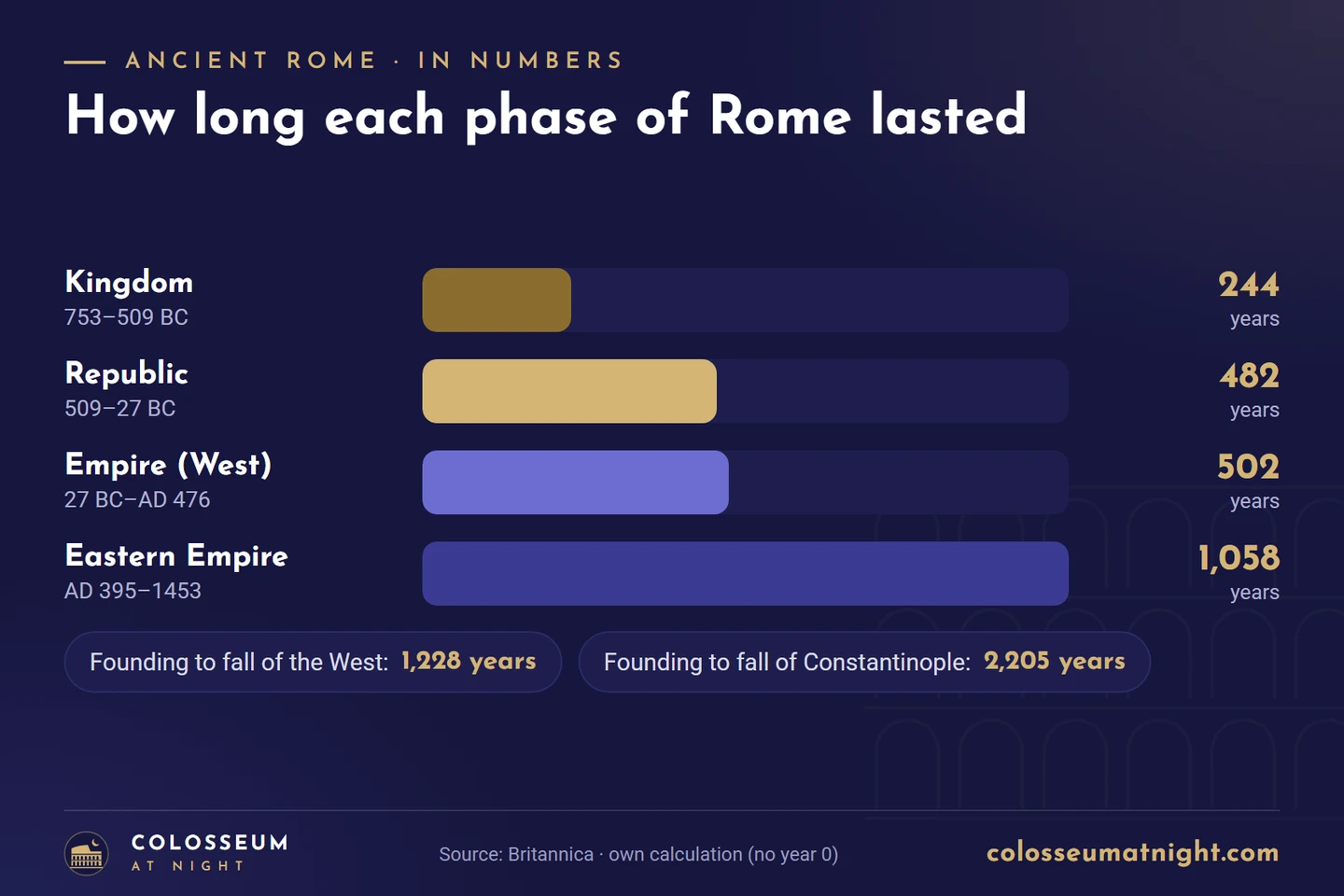
Ancient Rome lasted about 1,228 years, from its legendary founding in 753 BC to the fall of the Western Roman Empire in AD 476. If you count the Eastern Roman Empire, which ruled from Constantinople until the city fell in 1453, Roman rule lasted about 2,205 years. The empire alone, starting with Augustus in 27 BC, lasted 502 years in the West.
The answer depends on what you mean by "Rome": the city-state of the early kings, the Republic of the Senate and consuls, or the empire of the emperors. Each phase had its own government, and together they span more than two millennia. Below you will find every phase with exact dates, the durations worked out correctly, the moment Rome was at its peak, and why many historians say Rome did not really end until the 15th century.
How Long Did Rome Last? The Short Answer
Historians divide ancient Rome into three political phases, plus the eastern half of the empire that outlived the West by almost a thousand years.
| Phase | Dates | How long it lasted |
|---|---|---|
| Roman Kingdom | 753–509 BC | 244 years |
| Roman Republic | 509–27 BC | 482 years |
| Roman Empire (West) | 27 BC–AD 476 | 502 years |
| Eastern Roman Empire | AD 395–1453 | 1,058 years |
| Rome from founding to the fall of the West | 753 BC–AD 476 | 1,228 years |
| Rome from founding to the fall of Constantinople | 753 BC–AD 1453 | 2,205 years |
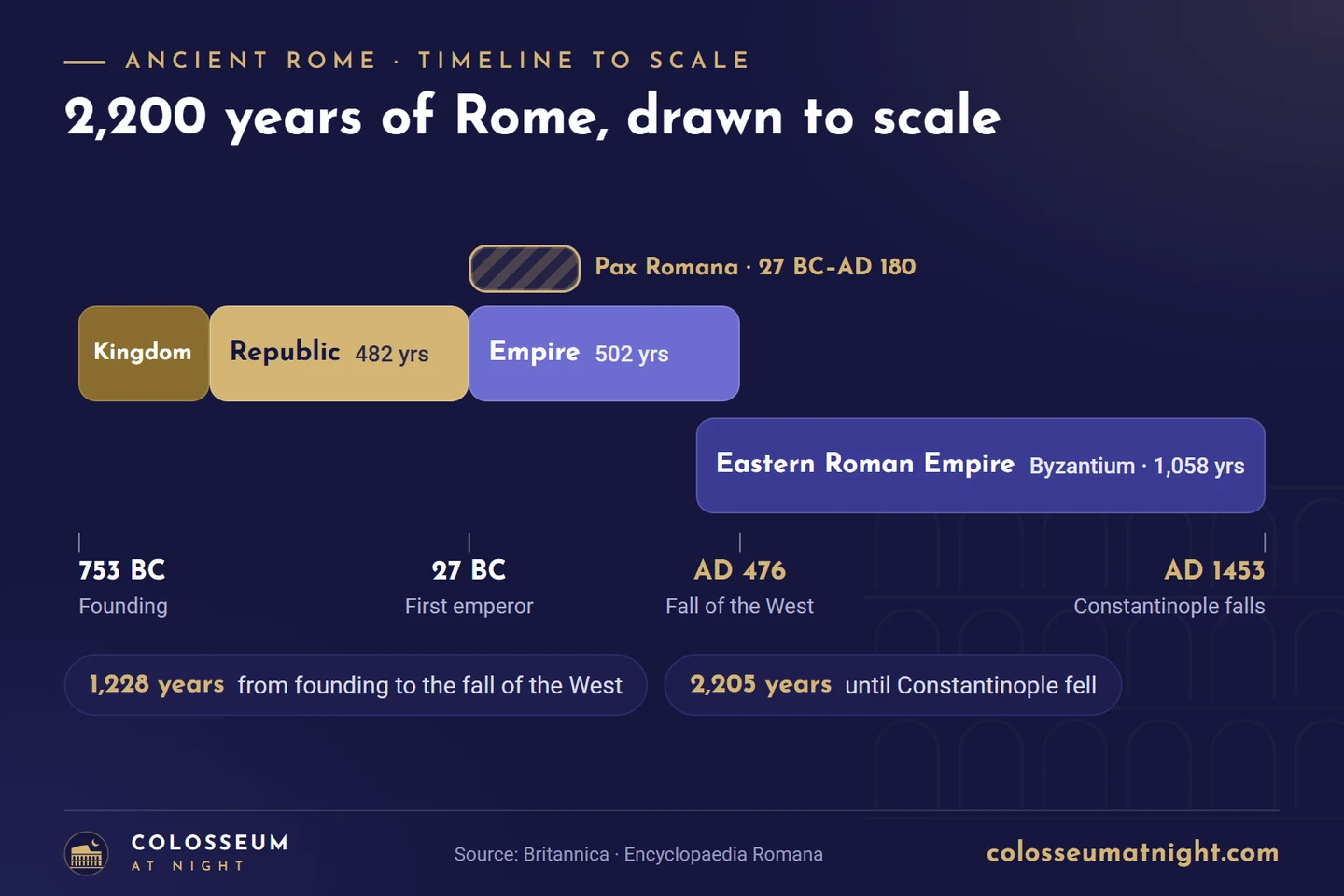
A quick note on the maths, because many websites get it wrong: there is no year 0. The calendar jumps from 1 BC straight to AD 1. That is why 753 BC to AD 476 is 1,228 years, not the 1,229 you get by simply adding 753 and 476.
The Roman Kingdom (753–509 BC)
According to Roman tradition, Romulus founded the city on the Palatine Hill on 21 April 753 BC. Romans still celebrate the city's birthday on that date every year. The founding story is a legend, but archaeology confirms that people lived on the Palatine from at least the 8th century BC. You can read more in our guide to when Rome was founded.
Rome was ruled by seven kings during this period, the last of them Tarquinius Superbus ("Tarquin the Proud"). When the Romans expelled him in 509 BC, they swore never to have a king again. The kingdom had lasted 244 years.
The Roman Republic (509–27 BC)
For the next 482 years, Rome was a republic. Two consuls, elected every year, led the state, and the Senate held enormous influence. During this period Rome grew from a city on the Tiber into the master of the Mediterranean. It defeated Carthage in the Punic Wars and conquered Greece, Spain and Gaul.
Success brought problems. Powerful generals with private armies fought each other in a century of civil wars. Julius Caesar was named dictator for life in 44 BC and was murdered on the Ides of March the same year. His adopted heir Octavian won the final civil war, and in 27 BC the Senate gave him the name Augustus. Britannica, like most historians, uses that date for the end of the Republic. The full story is in our article on who the first emperor of Rome was.
The Roman Empire (27 BC–AD 476)
The empire in the West lasted 502 years. Its first two centuries were the most stable in Roman history, a period known as the Pax Romana ("Roman peace"), which is usually dated from 27 BC to the death of Marcus Aurelius in AD 180.
When Was Rome at Its Peak?
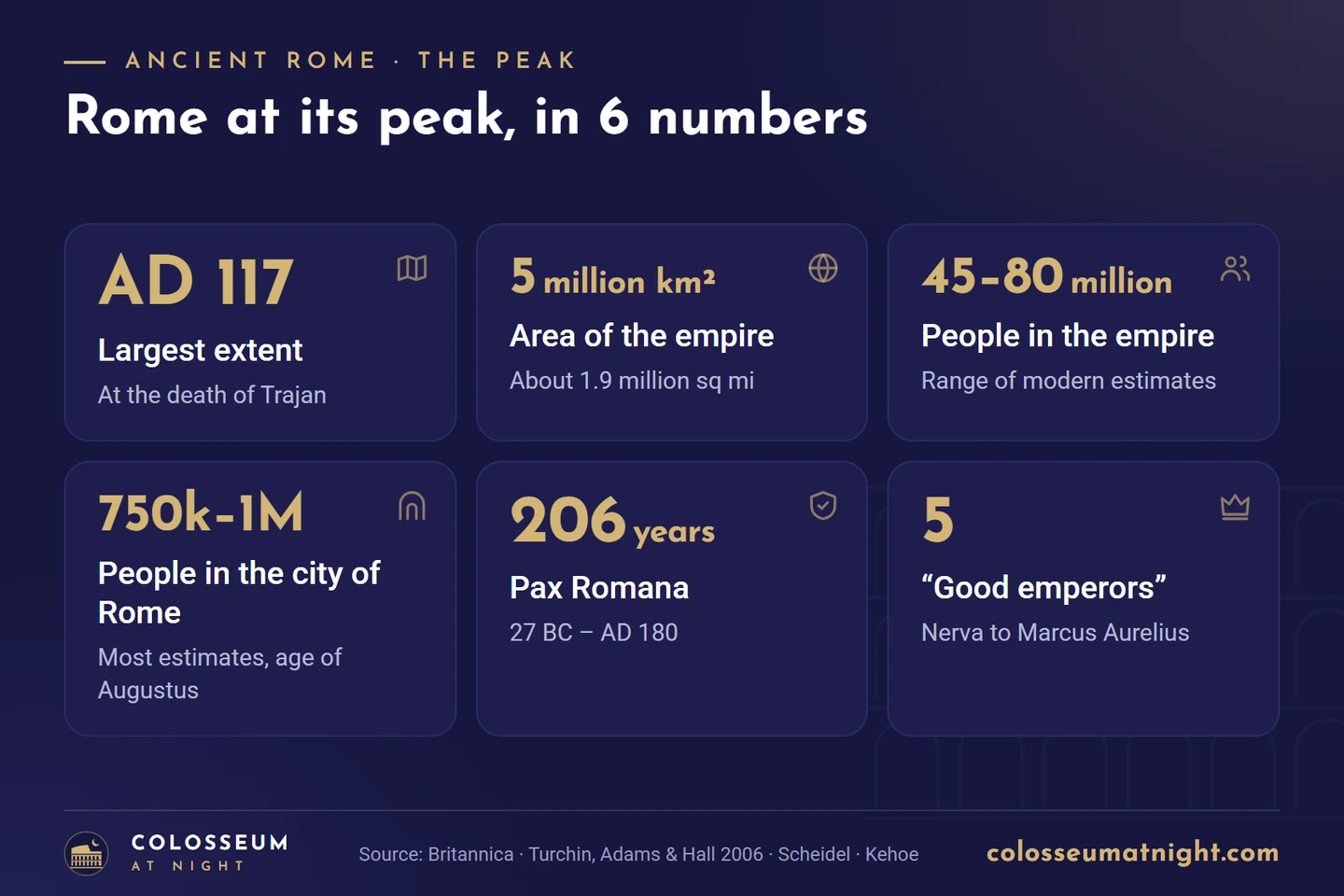
Rome reached its greatest size in AD 117, at the death of the emperor Trajan. At that moment it covered about 5 million square kilometres (1.9 million square miles), stretching from Britain to Mesopotamia. Modern estimates for its population range from about 45 to 80 million people, and the city of Rome alone had, on most estimates, between 750,000 and one million inhabitants already under Augustus.
The peak was brief. In the same year Trajan's successor Hadrian gave up the new eastern provinces of Armenia, Mesopotamia and Assyria. Trajan and Hadrian belonged to the so-called Five Good Emperors, from Nerva (AD 96) to Marcus Aurelius (AD 180), each chosen by adoption rather than by birth. The historian Edward Gibbon later called this the time when the human race was "most happy and prosperous".
The third century brought a long crisis: between 235 and 284 the empire saw more than 20 emperors, civil wars, invasions and a collapsing currency. Diocletian restored order and split the administration between several rulers, and Constantine founded a new capital on the Bosporus, Constantinople, in AD 330.
Why Did the Western Roman Empire End in 476?
After the death of Theodosius I in AD 395, the empire was divided for good between his two sons: one ruled the West from Italy, the other the East from Constantinople. The West grew steadily weaker. In August 410 the Visigoths under Alaric plundered Rome for three days, and in 455 the Vandals spent two weeks looting the city.
In 476, traditionally on 4 September, the Germanic commander Odoacer deposed the last western emperor, a teenager called Romulus Augustulus, and did not bother to appoint a new one. That year is the traditional end of the Western Roman Empire, although some historians count it until 480, when Julius Nepos, the last western emperor recognised by Constantinople, was murdered. Historians still debate the causes, from civil wars and money problems to pressure on the frontiers. We look at them in detail in why did Rome fall and in how the fall of Rome changed Western Europe.
The Eastern Roman Empire: Rome Until 1453
In the East, nothing "fell" in 476. The Eastern Roman Empire, which modern historians call the Byzantine Empire, carried on for almost another thousand years. Its people called themselves Romaioi, Romans, until the end. Under Justinian in the 6th century it even won back Italy, North Africa and part of Spain.
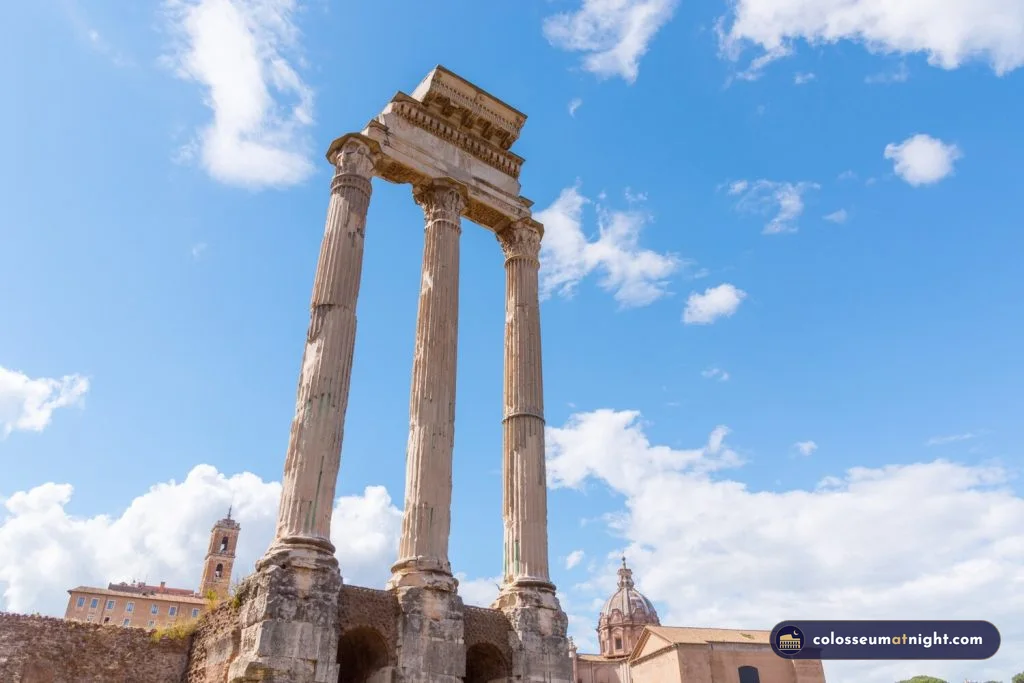
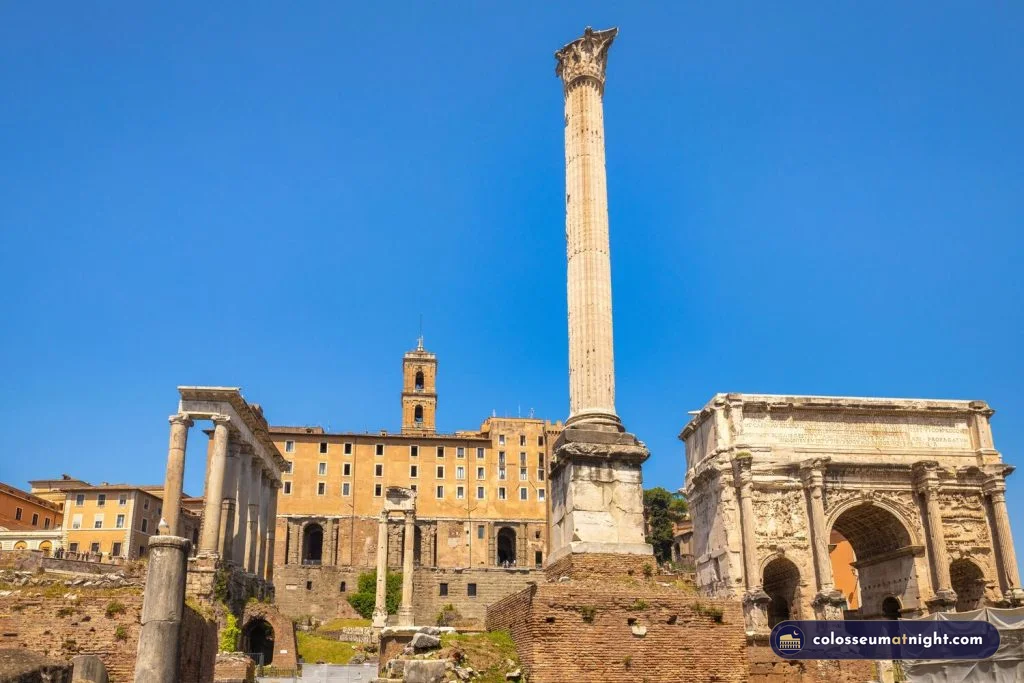 The Column of Phocas (AD 608) was the last monument added to the Roman Forum, long after the West had fallen.
The end came on 29 May 1453, when the Ottoman sultan Mehmed II captured Constantinople and the last emperor, Constantine XI, died defending its walls. Counted from the division of 395, the Eastern Empire lasted 1,058 years; counted from the founding of Constantinople in 330, it lasted 1,123 years.
How Long Did the Roman Empire Last?
This is a slightly different question, because it starts with Augustus rather than with Romulus. The answer is 502 years in the West (27 BC–AD 476) and 1,479 years if you follow the empire through its eastern half until 1453.
Does the Holy Roman Empire Count?
No. The Holy Roman Empire, which traces back to Charlemagne's coronation in Rome on Christmas Day AD 800 and ended in 1806, was a mostly German state that borrowed the Roman name and idea. It had no direct continuity with the ancient empire. Voltaire famously joked that it was "neither holy, nor Roman, nor an empire".
See 2,200 Years of Rome in One Walk
The best way to understand how long Rome lasted is to walk through it. In the Roman Forum you can stand where the kings, the Republic and the emperors all left their mark within a few hundred metres. The Curia, where the Senate met, stands near the Arch of Septimius Severus (AD 203), and the Column of Phocas (AD 608) rises close to both. Just outside the Forum, the Arch of Constantine (AD 315) and the Colosseum (AD 80) show the empire at its grandest.
Plan your visit with our guide to Roman Forum tickets and opening hours. And if you want to see the arena when it is quiet and floodlit, a Colosseum night tour takes you inside after the day crowds have gone.
Frequently Asked Questions
How long did the Roman Empire last?
How long did ancient Rome last in total?
When was Rome at its peak?
How long did the Roman Republic last?
When did Rome officially fall?
Sources
- there is no year 0 · eclipse.gsfc.nasa.gov
- Britannica · britannica.com
- captured Constantinople · britannica.com
Sources linked in this article · Last updated: 4 Nov 2026

Founder of PortalWeb GmbH, a Swiss web agency, and a passionate traveler. Every fact on Colosseum at Night is checked against official sources and kept up to date.
Comments