
On this page · 8 sections
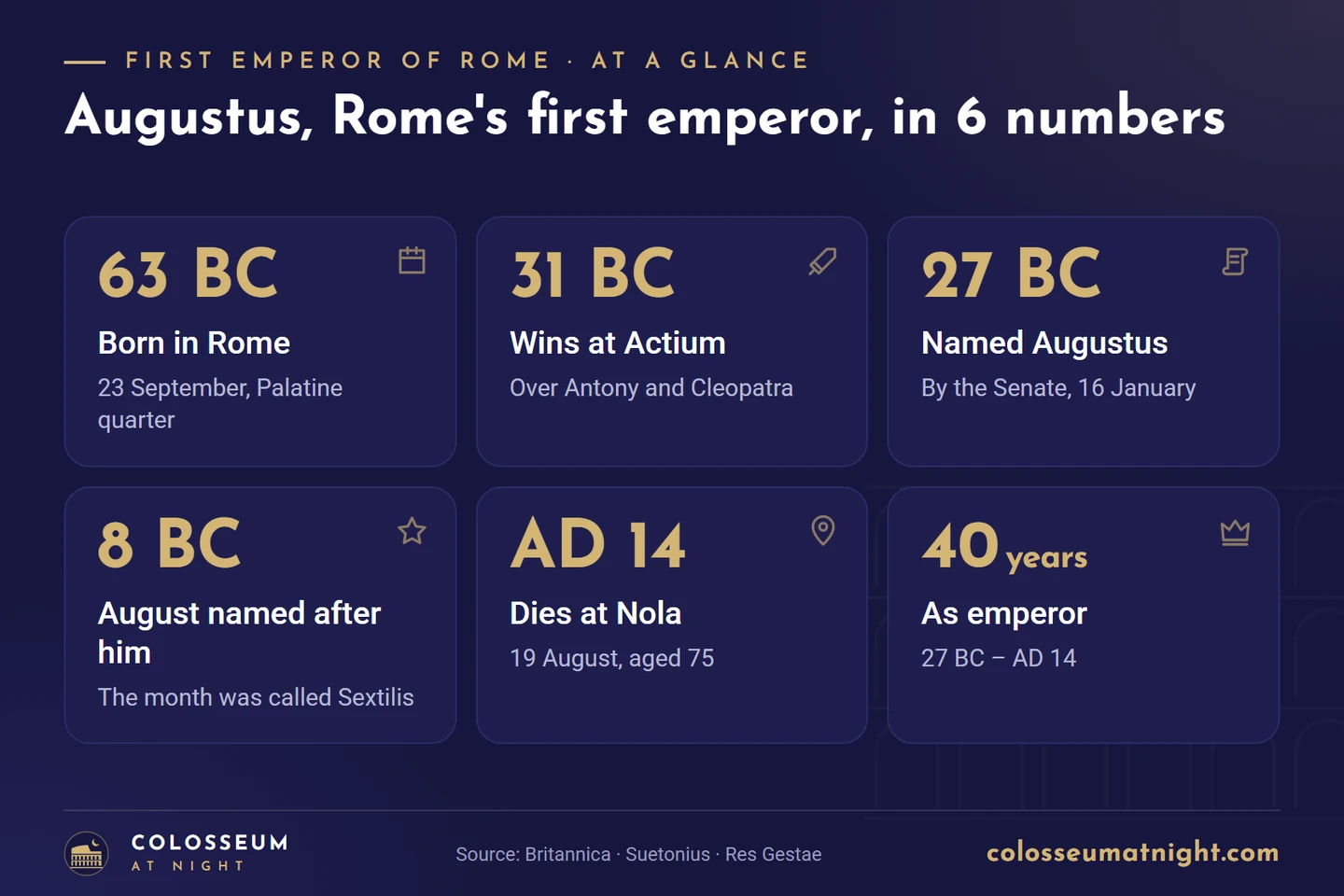
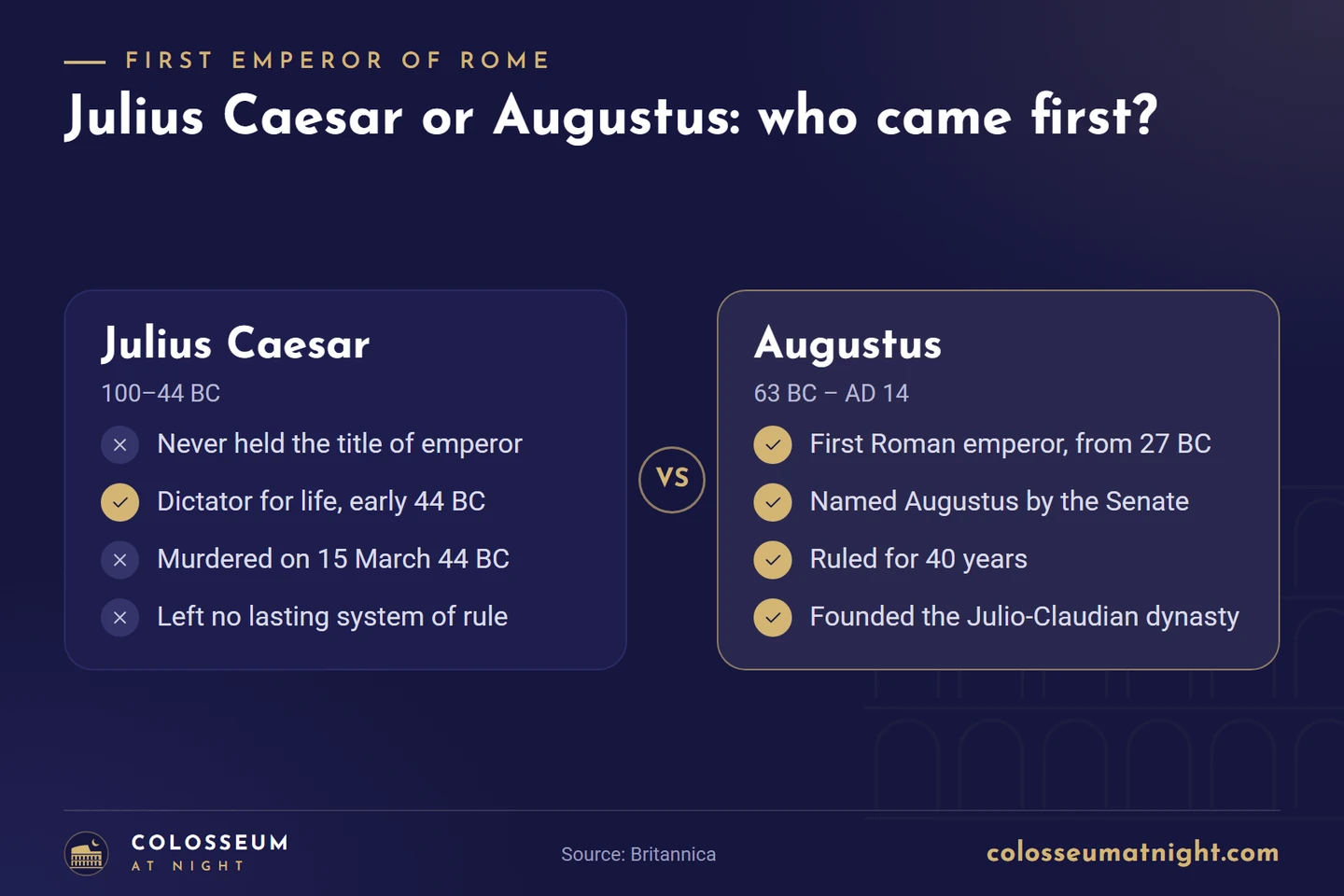
The first emperor of Rome was Augustus, born Gaius Octavius, who ruled from 27 BC until his death in AD 14. On 16 January 27 BC the Roman Senate gave him the name "Augustus", the date most historians use for the start of the Roman Empire. Julius Caesar, his great-uncle and adoptive father, was a dictator, never an emperor.
Augustus turned a republic worn out by civil war into an empire that lasted for centuries, yet he never called himself king or emperor. Below you will find who he was, how he took power step by step, why so many people think Julius Caesar came first, and the places in Rome where you can still follow in his footsteps.
Who Was Augustus?
Augustus was born Gaius Octavius on 23 September 63 BC in Rome, in the Palatine quarter, according to his biographer Suetonius. His father's family came from Velitrae (today's Velletri), a town in the hills south of Rome. His mother, Atia, was the niece of Julius Caesar, which made Caesar his great-uncle.
Caesar had no legitimate son. In his will he adopted Octavius and made him his chief heir. When Caesar was murdered in March 44 BC, the 18-year-old took the name Gaius Julius Caesar. Historians call him Octavian for the years before 27 BC, to avoid confusing him with his famous adoptive father.
He ruled for more than four decades and died at Nola, near Naples, on 19 August AD 14, aged 75. A month later, on 17 September, the Senate declared him a god.
How Did Octavian Become Emperor?
Octavian did not seize power in a single day. It took him 17 years of politics and war.
First he joined forces with Caesar's general Mark Antony and the politician Lepidus. In November 43 BC the three men were formally appointed as the Second Triumvirate, with near-total power. Together they defeated Caesar's assassins Brutus and Cassius at Philippi in 42 BC.
The alliance did not last. Antony ruled the eastern provinces with Cleopatra, queen of Egypt, while Octavian held Italy and the West. On 2 September 31 BC, Octavian's fleet, commanded by his friend Marcus Agrippa, beat Antony and Cleopatra at the Battle of Actium off the coast of Greece. A year later both had taken their own lives, and Egypt became a Roman province.
Octavian was now the only man with an army that mattered. In January 27 BC he made a show of handing the state back to the Senate. Four days later, on 16 January 27 BC, the grateful senators gave him the name Augustus, meaning "the revered one". Some had wanted to call him Romulus, after Rome's founder.
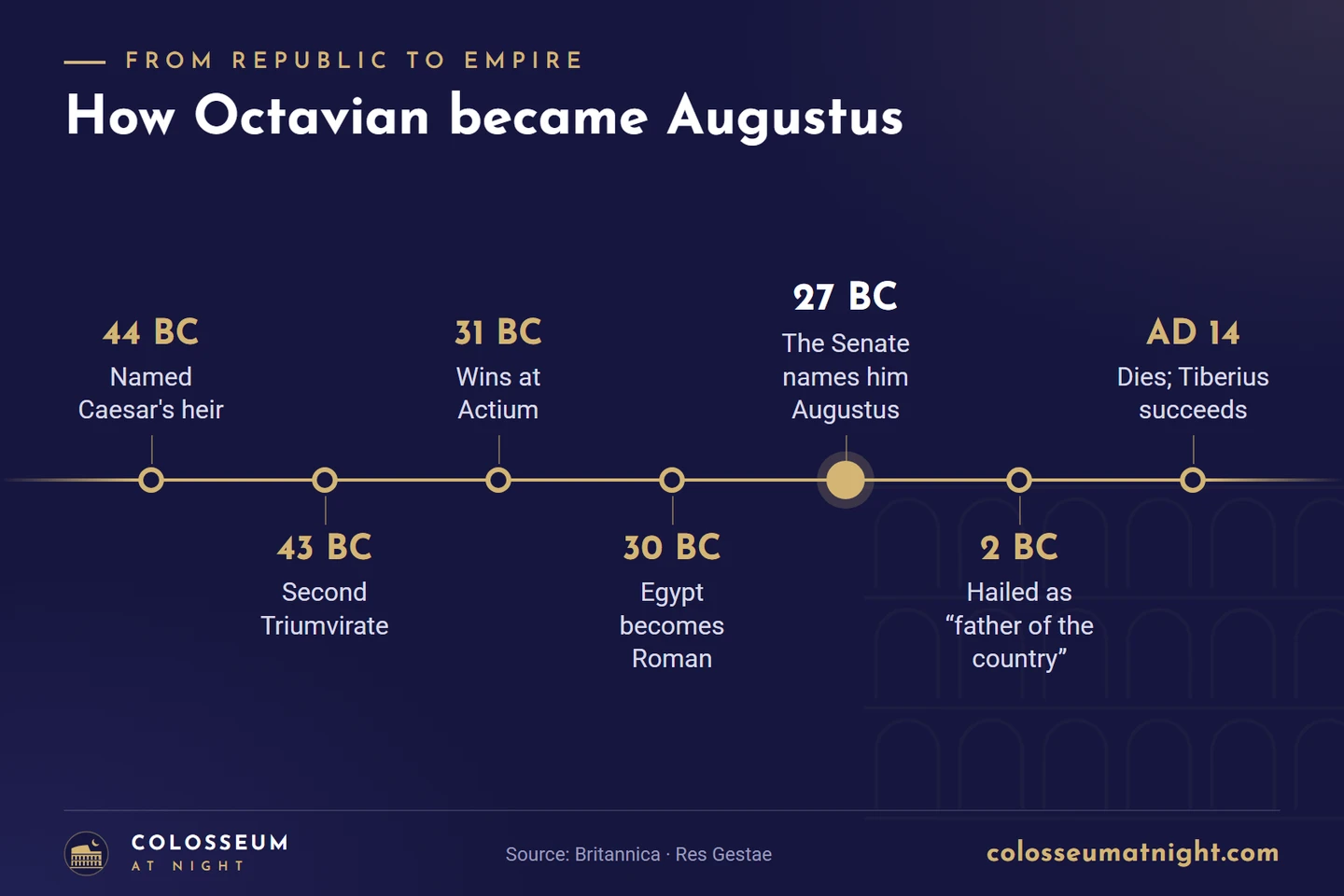
From Republic to Empire in a short timeline
| Date | What happened |
|---|---|
| 15 March 44 BC | Julius Caesar is murdered; his will names Octavian as his heir |
| 27 November 43 BC | Octavian, Mark Antony and Lepidus form the Second Triumvirate |
| 2 September 31 BC | Octavian's fleet wins the Battle of Actium |
| 30 BC | Antony and Cleopatra die; Egypt is annexed by Rome |
| 16 January 27 BC | The Senate names him Augustus: the Roman Empire begins |
| 23 BC | He receives the powers of a tribune for life |
| 5 February 2 BC | He is honoured as pater patriae, "father of the country" |
| 19 August AD 14 | Augustus dies at Nola; his stepson Tiberius succeeds him |
When Did Rome Become an Empire?
Most historians date the beginning of the Roman Empire to 27 BC, the year Octavian became Augustus. Britannica, for example, dates the Roman Republic from 509 to 27 BC. Some historians prefer 31 BC, the year of Actium, because that victory left Octavian without a rival.
What makes the question tricky is that nothing officially changed. The Senate kept meeting, consuls were still elected and Augustus insisted the Republic had been restored. He presented himself as the princeps, the "first citizen", an informal label rather than an official title. The real power lay in the army, the provinces he controlled and the authority of a tribune, which he held for life from 23 BC. The Romans themselves counted an emperor's years of rule from that tribunician power.
So the empire did not begin with a coronation. It began when one man quietly held all the powers that the Republic had once divided.
Was Julius Caesar the First Emperor of Rome?
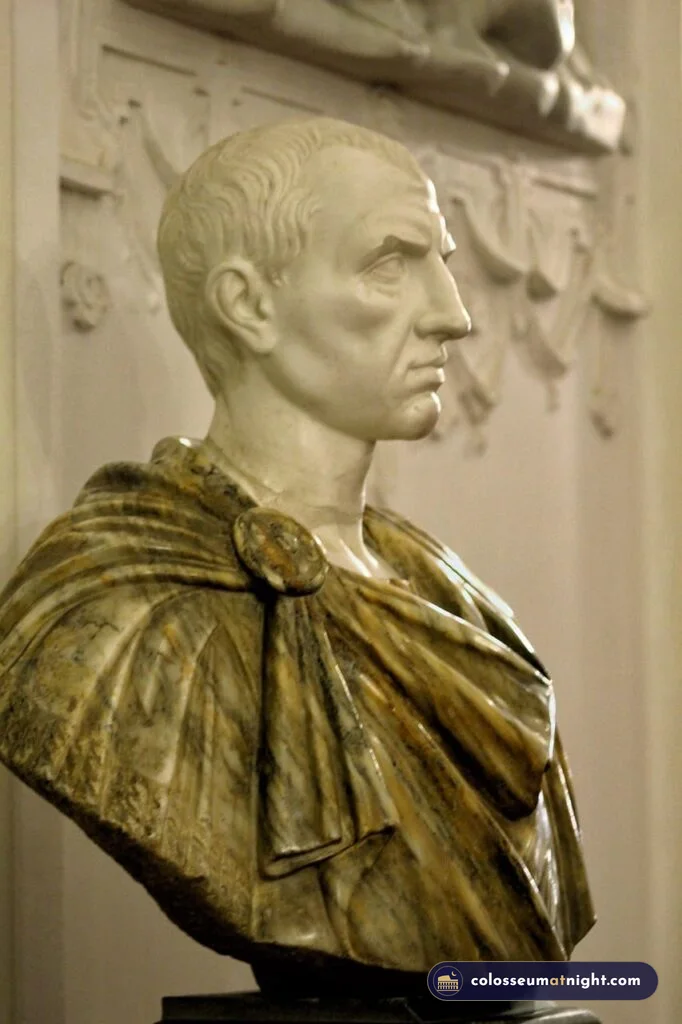
No. Julius Caesar was never a Roman emperor. He was a general and politician who held the office of dictator, a recognised, normally temporary office of the Roman Republic. In early 44 BC he was named dictator for life, and only weeks later, on the Ides of March (15 March) 44 BC, he was stabbed to death by a group of senators who feared he wanted to become king.
There are three reasons people still call him the first emperor:
- His name became the word for emperor.. "Caesar" was his family name. Augustus and later rulers took it on, and it turned into a title that lives on in the German Kaiser and the Russian tsar.
- "Imperator" sounds like "emperor".. It originally meant "commander" and was a title soldiers gave a victorious general. Caesar used it, and Octavian made it part of his own name.
- A famous book starts with him.. Suetonius's Lives of the Twelve Caesars, written in the 2nd century AD, begins with Julius Caesar, so he looks like number one in the list.
The difference is that Caesar left behind no lasting system of government and no secure succession. Augustus built both.
What Did Augustus Do for Rome?
Augustus's rule began the Pax Romana, the "Roman peace", a period of about two centuries of relative stability that historians usually date from 27 BC to the death of Marcus Aurelius in AD 180.
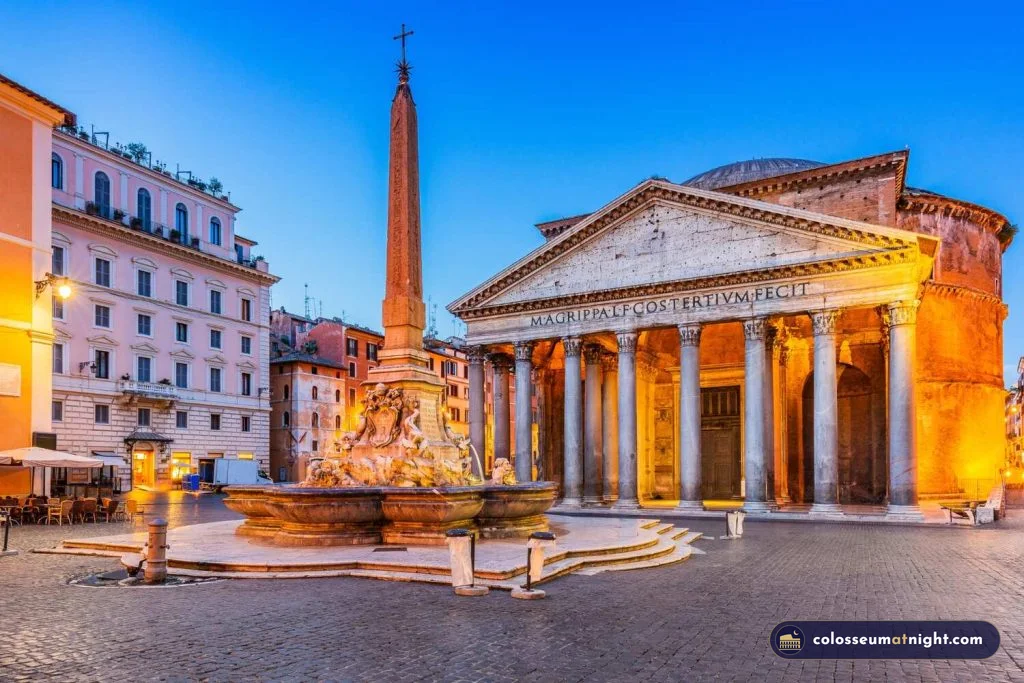
He also transformed the city itself. Suetonius reports that Augustus boasted he had found Rome built of brick and left it in marble. In his own account of his reign, the Res Gestae, he lists 82 temples he restored in a single year, 28 BC. He built the Forum of Augustus with its Temple of Mars Ultor, inaugurated in 2 BC, and the Ara Pacis, the Altar of Augustan Peace, dedicated on 30 January 9 BC. His friend Marcus Agrippa built the first Pantheon, whose inscription still carries Agrippa's name.
Even the calendar remembers him. In 8 BC the month Sextilis was renamed August in his honour. He picked it over his birth month, September, because his first consulship and his greatest victories had fallen in it.
The First Roman Emperors After Augustus
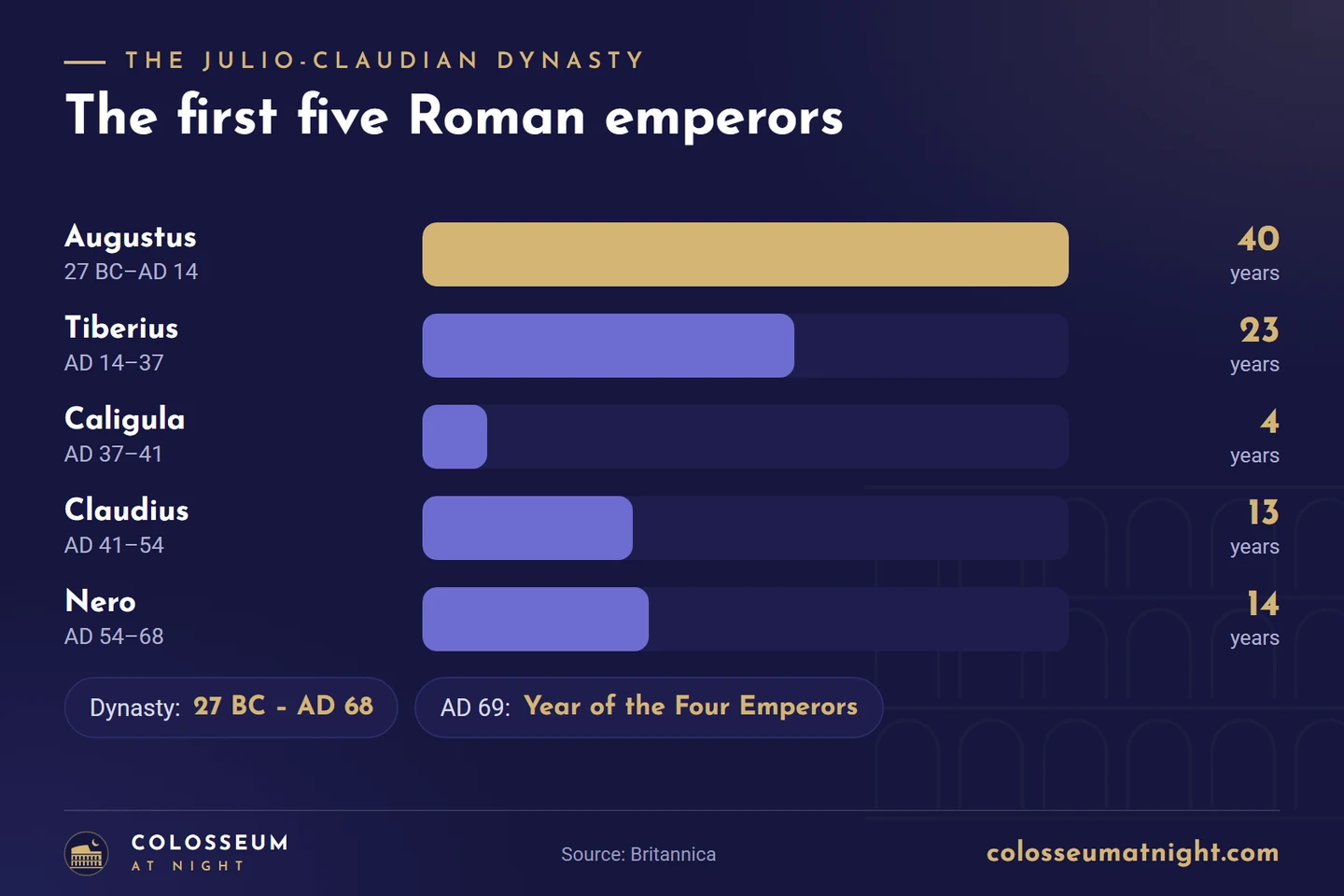
Augustus spent years trying to find an heir. In the end he adopted his stepson Tiberius in AD 4, and Tiberius took over when Augustus died. Their family, known as the Julio-Claudian dynasty, ruled until the death of Nero in AD 68.
| Emperor | Reign | Years in power |
|---|---|---|
| Augustus | 27 BC–AD 14 | 40 |
| Tiberius | AD 14–37 | 23 |
| Caligula | AD 37–41 | 4 |
| Claudius | AD 41–54 | 13 |
| Nero | AD 54–68 | 14 |
It was under Tiberius that Jesus was crucified in Judea, as we explain in which Roman emperor ruled when Jesus died. After Nero's death, AD 69 became the Year of the Four Emperors, and the winner, Vespasian, went on to build the Colosseum.
Where to See Augustus's Rome Today
Augustus's Rome is still all around you in the city centre. Here is what you can see in 2026:
- Ara Pacis Museum. The marble altar stands inside a modern glass pavilion on the Tiber. It is open daily from 9:30 to 19:30 (last entry 18:30), and a full ticket costs €14, according to the Ara Pacis Museum. Look for the Res Gestae, Augustus's account of his own reign, carved on the museum's outer wall facing his Mausoleum.
- Mausoleum of Augustus. The huge round tomb next door has been closed for works since June 2022. The city expects the works to finish at the end of 2026, but no reopening date had been announced when we checked in November 2026. You can still see it from Piazza Augusto Imperatore.
- Forum of Augustus. You can look down into the ruins of his forum and the Temple of Mars Ultor for free from Via dei Fori Imperiali, on the walk between the Colosseum and Piazza Venezia.
- Palatine Hill. Augustus was born in the Palatine quarter and lived on the hill. His house there belongs to the Colosseum archaeological park, but access depends on the ticket type and the opening days, so check the official park website before you go. Our guide to Roman Forum tickets and opening hours explains the options.
- The Augustus of Prima Porta. The most famous statue of Augustus stands in the Braccio Nuovo (New Wing) of the Vatican Museums.
The Roman Forum, the Palatine and the Colosseum lie side by side, so you can see the world Augustus created and the arena his successors built in one visit. For the most atmospheric version, join one of the best Colosseum night tours, when the monuments are floodlit and the crowds have gone. To see how the story ends, read how long Rome lasted after Augustus.
Frequently Asked Questions
Who was the first true emperor of Rome?
Was Julius Caesar an emperor?
How long did Augustus rule Rome?
Who ruled Rome after Augustus?
What is the difference between a Caesar and an emperor?
Sources
- Ara Pacis Museum · arapacis.it
- Vatican Museums · museivaticani.va
Sources linked in this article · Last updated: 4 Nov 2026

Founder of PortalWeb GmbH, a Swiss web agency, and a passionate traveler. Every fact on Colosseum at Night is checked against official sources and kept up to date.
Comments